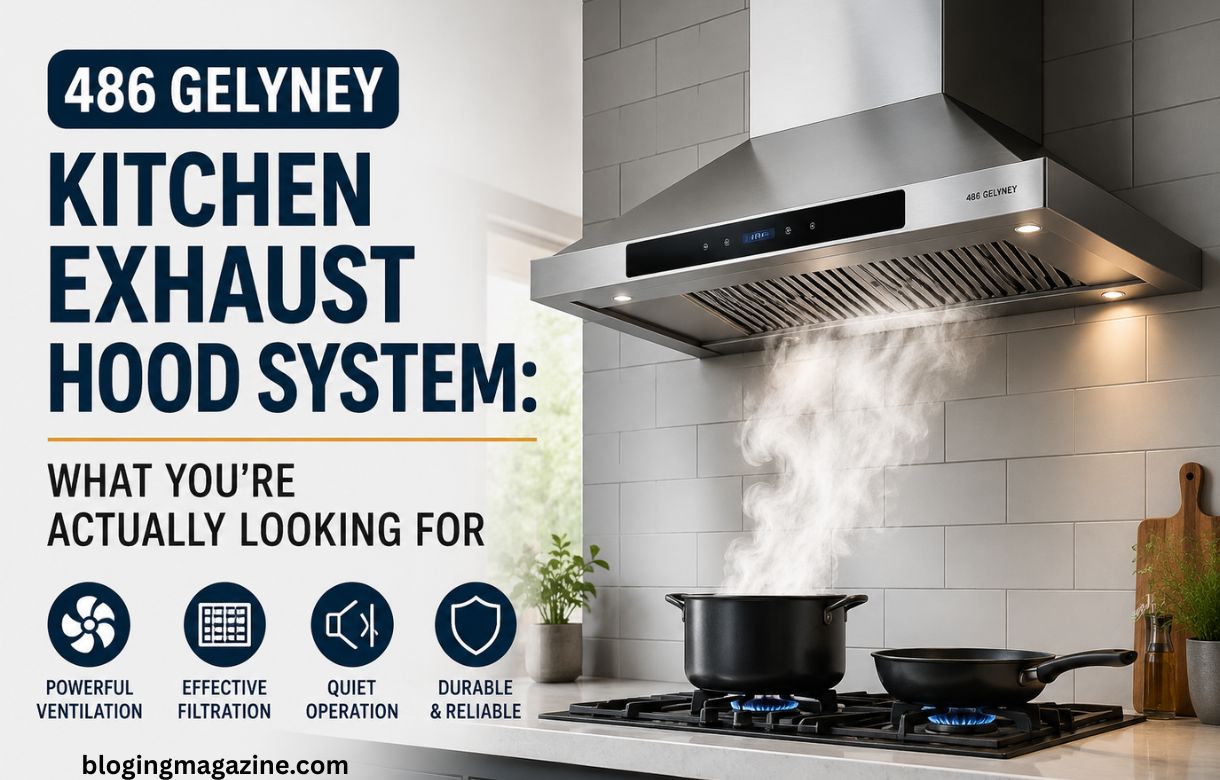
If you’ve searched for the “486 Gelyney kitchen exhaust hood system,” you’ve probably come away more confused than informed.
A handful of articles online describe it in loving detail — dual motors, auto-cleaning filters, smart controls, even a “48.6-centimeter width.” But there’s no manufacturer behind the name. No listing on any retailer’s shelf. No spec sheet you can hold up against a real product.
What you’re actually seeing is a keyword that got picked up and rewritten by several content sites, each adding just enough plausible detail to sound authoritative — without any of it tracing back to an actual company.
That’s frustrating if you’re trying to make a real decision about your kitchen. So instead of pretending a phantom product is real, let’s walk through what a genuine kitchen exhaust hood system actually does, what separates a good one from a mediocre one, and what to check before you buy.
What a Kitchen Exhaust Hood Is Actually Doing
Every functional range hood relies on the same basic physics, regardless of brand.
Heat from cooking causes air to rise. That rising column carries smoke, steam, and airborne grease with it.
A hood mounted above the stove intercepts that column before it spreads across the room. A motor inside creates suction strong enough to pull it into the unit, rather than letting it drift toward your cabinets, walls, and lungs.
Why Fan Speed Matters More Than You’d Think
The quality of a hood comes down to how well it manages the airflow at different intensities.
A hard sear or a wok full of oil needs serious motor power. A pot of simmering soup doesn’t.
That’s why most decent units offer two to four fan speeds rather than a single on/off switch. Cooking generates wildly different amounts of smoke depending on what’s on the stove, and a hood that only does “on” and “off” will either be too loud or too weak most of the time.
Filtration Is Where Cheap Units Fall Apart
Suction alone doesn’t make a hood effective. What happens to the air after it’s pulled in matters just as much — and it’s usually where budget or knockoff products cut corners.
Grease Filters
A grease filter — typically an aluminum mesh or stainless-steel baffle plate — is the first thing air passes through. It catches oil particles before they coat the motor or get pushed back into the room.
These need regular cleaning, generally every two to four weeks, depending on how often you cook. A clogged filter forces the motor to work harder, drives up electricity use, and eventually chokes the airflow entirely.
Carbon Filters
If your hood doesn’t vent outside through ductwork, it’s a recirculating system that relies on an activated carbon filter to neutralize odors before releasing air back into the kitchen.
Unlike a grease filter, carbon can’t be washed and reused. It absorbs smells until it’s saturated, then needs full replacement — usually every three to six months.
Skipping that replacement is the single most common reason people complain that a recirculating hood “stopped working.” It didn’t. The filter just gave up.
Ducted vs. Recirculating: The Decision That Actually Matters
This is the real fork in the road when choosing a system — and it matters far more than any brand name.
Ducted Hoods
A ducted hood pushes captured air through a pipe straight outside the building.
It’s the most effective option by a wide margin, since nothing gets recirculated. Smoke, grease, and odor all leave the house entirely.
The tradeoff: it requires actual ductwork, which isn’t always feasible in an apartment or a kitchen without easy access to an exterior wall.
Recirculating Hoods
A recirculating hood skips the ductwork. It filters air through grease and carbon filters, then releases it right back into the room.
Installation is far simpler, which is why it’s the default in most apartments. But it demands more disciplined maintenance. Without fresh carbon filters, odor control degrades noticeably over time — even if the motor itself runs fine.
Installation Height and Duct Routing Change Everything
Even a genuinely well-built hood underperforms if it’s mounted wrong.
Most manufacturers recommend somewhere between 65 and 75 centimeters above a gas cooktop. Above an electric or induction surface, aim slightly higher — roughly 75 to 85 centimeters.
Mount it too high, and smoke disperses sideways before the hood can catch it, no matter how strong the motor is.
Keep Ductwork Short and Straight
If you’re going the ducted route, keep the duct path as short and straight as possible.
Every bend adds resistance. A long run with multiple turns can quietly cut your actual suction power in half compared to what the unit is rated for — one reason two hoods with identical spec sheets can perform very differently once installed.
What to Actually Check Before Buying
Skip the marketing copy. Look at a few concrete numbers instead.
Airflow (CFM). This tells you how much air the motor can move. Something in the 400–600 CFM range covers most home cooking; heavier or commercial use calls for 600 CFM and up.
Noise level. Usually listed in sones or decibels — lower is better. Compare at both low and high fan speeds, since some hoods that seem quiet at idle turn into jet engines at full power.
Filter type and replacement cost. A hood that’s cheap to buy but expensive to keep filtered isn’t actually saving you money.
A Quick Warning Sign
If a listing leans heavily on vague superlatives — “revolutionary,” “game-changing,” “the appliance everyone’s talking about” — without a manufacturer name, model number, or place to actually buy it, treat that as a signal to keep looking rather than a reason to get excited.
The Bottom Line
There’s no real “486 Gelyney” system to recommend, for or against.
But the questions that search brought you here to answer are worth answering honestly: how does a kitchen exhaust hood actually work, what’s the difference between ducted and recirculating, and how do you keep one running well?
A hood that’s properly sized, correctly installed, and maintained on a real filter schedule will outperform any unit chasing a trend — whether that trend has a real name behind it or not.
Frequently Asked Questions
What does 400 CFM mean for a range hood?
CFM is simply the volume of air a hood’s motor can push through in a minute — it’s the main number that tells you how powerful the extraction is. A 400 CFM unit sits toward the modest end of the scale, fine for routine cooking like simmering, boiling, or a light pan-fry. Anyone who cooks at high heat often, chars meat, or does heavy wok work should size up to 600 CFM or beyond.
How do you pick a good kitchen hood?
There isn’t one universal winner — the right choice depends on your kitchen and what you’re willing to spend. Established international brands such as Faber, Elica, and Bosch are easy to find through local appliance dealers, and there are also solid regional options in most major cities. Instead of fixating on a brand, focus on matching the CFM to your stove’s size, checking whether ducted venting is realistic for your kitchen (a real advantage given how oil-heavy a lot of local cooking is), and confirming that replacement filters are actually easy to source afterward.
In plain terms, what is a kitchen hood system?
It’s the whole setup working together — the hood itself sits above the cooktop and catches rising steam, smoke, and grease, a motor draws that air through a set of filters, and from there it’s either pushed out of the house through ducting or cleaned and sent back into the room in a recirculating design.
What hood size fits a 48-inch range?
The general guideline is to match or slightly exceed the width of the cooktop. For a 48-inch range, that means choosing a hood somewhere between 48 and 54 inches, so it fully spans the burners and doesn’t let smoke slip out past the sides uncaptured.