🌿 Scandinavian Home & Heritage
Table of Contents
TogglePyntekvister The Nordic Art of Decorative Branches
From ancient forest rituals to modern minimalist interiors — explore the rich world of Pyntekvister, Scandinavia's timeless tradition of bringing the beauty of nature indoors.
What Is It?
The Meaning of Pyntekvister
The Norwegian word Pyntekvister (pronounced POON-teh-KVIS-ter) translates literally as "decorative branches" or "ornamental twigs." Derived from the Norwegian pynte — meaning "to decorate" or "to adorn" — and kvister, the plural of kvist, meaning "branch" or "twig," the term captures a deeply Nordic sensibility: that nature's simplest offerings are also its most beautiful.
At its heart, Pyntekvister is the practice of bringing branches, twigs, bare boughs, or florally decorated stems indoors, either as raw sculptural elements or adorned with ornaments, paper crafts, dried flowers, lights, and seasonal accents. The result is an arrangement that is simultaneously organic and intentional — wild yet curated.
Unlike conventional floral arrangements, Pyntekvister celebrates the branch itself: its silhouette, its texture, its age. A single bare birch branch in a tall glass vase can carry more visual weight than an elaborate bouquet.
"In Scandinavia, the forest has never been something to fear or tame — it is something to welcome inside, to live alongside, to celebrate through every season."— Nordic Design Quarterly
Cultural Heritage
Ancient Roots: The History of Pyntekvister
The tradition of decorative branches in Scandinavian culture stretches back thousands of years, woven into the fabric of Norse mythology, agricultural ritual, and seasonal celebration. Long before the concept of "home decor" existed as a modern idea, Nordic peoples were adorning their homes and sacred spaces with branches that carried symbolic meaning.
In pre-Christian Norse culture, specific trees held immense spiritual power. The birch was sacred to Frigg, goddess of hearth and home. Juniper branches were hung over doorways to ward off illness and evil spirits. Pine and spruce boughs signaled endurance through the dark months of winter, a promise that life would return. These were not merely decorative impulses — they were acts of reverence, protection, and communion with the natural world.
The Sacred Trees of Norse Tradition
Birch (Bjørk): Symbol of new beginnings, associated with Frigg. Used in spring rituals and birth celebrations.
Rowan (Rogn): The "protection tree," hung over doorways and stables to guard against misfortune.
Pine & Spruce: Evergreen symbols of eternal life, used throughout winter to remind inhabitants of the coming spring.
Willow (Pil): Linked to water spirits and dreams. Its long, trailing branches used in water-side ceremonies.
Juniper (Einer): Burned to purify a home or cleanse illness. Branches placed under beds and near cradles.
The formal tradition of Pyntekvister as we recognize it today — branches arranged in vessels as purposeful decor — crystallized during the 18th and 19th centuries in Norway, Sweden, and Denmark. As Scandinavian folk art flourished, the crafting of decorated Pyntekvister for Easter, Christmas, and midsummer became an important household tradition, especially in rural communities where connection to the land was an everyday reality.
By the 20th century, Pyntekvister had evolved from folk custom into an integral element of the Scandinavian design philosophy that would influence the entire world — the idea that beauty, nature, and function belong together in the home.
The Philosophy
Why Pyntekvister? The Nordic Love of Natural Beauty
To understand Pyntekvister is to understand the Nordic relationship with nature itself. In countries where winters are long, dark, and isolating, the psychological importance of bringing nature indoors cannot be overstated. Scandinavians have long understood intuitively what modern environmental psychology now confirms: contact with natural elements reduces stress, boosts mood, and creates a sense of grounded well-being.
Pyntekvister is deeply connected to the Danish concept of hygge — the creation of cozy, present-moment comfort. A branch in a corner invites you to slow down and notice.
Modern science calls it biophilia — the human need for connection to nature. Pyntekvister fulfills this need with elegance, bringing the texture and form of the forest into urban spaces.
Unlike cut flowers, branches are found, foraged, or pruned from existing trees, creating zero-waste decor that costs nothing and leaves no environmental footprint.
Every branch is unique — its silhouette unrepeatable. Pyntekvister turns natural forms into living sculptures that change with light, season, and time.
Changing your Pyntekvister with the seasons creates a living calendar in your home, connecting daily life to the natural cycles of the year.
There are no rigid rules. A Pyntekvister can be austere and architectural or wildly festive — the form is endlessly adaptable to personal taste.
Aesthetics
Pyntekvister and Scandinavian Style
The aesthetic language of Pyntekvister is inseparable from the broader visual vocabulary of Scandinavian design: clean lines, honest materials, functional beauty, and a deep respect for the natural world. In contemporary Scandinavian interiors, Pyntekvister functions as both decoration and philosophy made visible.
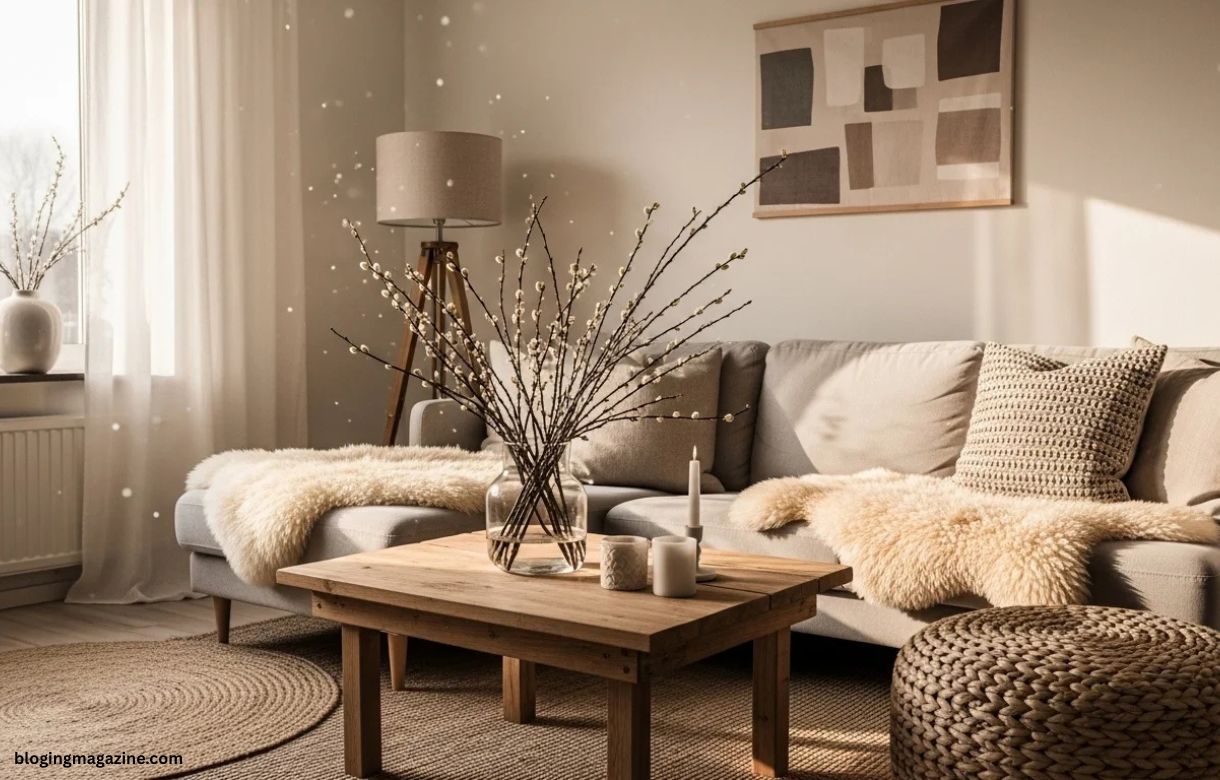
In the purest Nordic approach, a single dramatic branch — perhaps a tall, bare silver birch or the arching form of a dried willow — placed in a tall ceramic or glass vessel becomes the room's focal point. The branch does not compete for attention; it commands it through simplicity and form. This approach aligns with the Swedish concept of lagom — not too much, not too little — and reflects a design sensibility that trusts restraint over abundance.
"A single branch, carefully chosen, says more about a room than a hundred decorative objects. It says: here live people who understand silence."— Ingrid Holt, Interior Designer, Oslo
Color plays a crucial role. In winter, bare white or grey branches against a white wall create an almost calligraphic effect — lines drawn in space. In spring, the same vessel might hold branches of cherry blossom or pussy willow, bringing explosive softness. Autumn calls for branches heavy with berries, dried seed pods, or copper-toned dried grasses. The vessel matters too: raw stoneware, aged terracotta, clear glass, hammered copper — each material creates a distinct dialogue with the organic form it holds.
- Match the vessel height to the branch length — typically branches should be 1.5 to 2 times the height of the vase for visual balance.
- Odd numbers of branches (1, 3, or 5) create more natural-looking arrangements than even numbers.
- Allow air and negative space — overcrowding destroys the elegant silhouette that defines great Pyntekvister.
- Position branches near windows to capture changing light and create evolving shadow play throughout the day.
- Combine different textures within one arrangement: smooth bark with lichen-covered twigs, for example.
- In small spaces, a single specimen branch creates more impact than a cluster of smaller pieces.
Sustainability
The Eco-Conscious Heart of Pyntekvister
In an era of growing environmental awareness, Pyntekvister represents one of the most sustainable forms of home decoration imaginable. The practice requires no manufacturing, generates no packaging waste, involves no industrial supply chains, and — when branches are responsibly foraged — leaves the living landscape essentially undisturbed.
Foraging your own Pyntekvister connects you to the rhythms of your local environment in a meaningful way. Learning which trees produce the most beautiful bare branch structures in winter, which shrubs burst into color in spring, which grasses dry gracefully for autumn arrangements — this knowledge, accumulated over years, deepens your relationship with the natural world around you.
Responsible Foraging
- Never take more than 10% of branches from any single tree or shrub.
- Always cut cleanly at an angle with sharp pruning shears to prevent disease.
- Avoid foraging from protected areas, nature reserves, or private land without permission.
- Prefer pruning from your own garden — this benefits both your Pyntekvister and the plant's health.
- Dried and preserved branches can be reused across multiple seasons.
Best Eco-Friendly Branches
- Birch: Beautiful silver bark, excellent year-round. Prune in late winter.
- Forsythia: Can be forced to bloom indoors in winter; stunning yellow flowers.
- Willow: Flexible, long-lived once dried. Excellent structure.
- Eucalyptus: Fragrant, silver-green, air-purifying, long-lasting.
- Dried grass plumes: Zero-footprint, architectural, beautiful in tall vessels.
Hands On
DIY Pyntekvister: Create Your Own Nordic Branch Arrangement
Creating a beautiful Pyntekvister requires no special skill — only attention, patience, and a willingness to see the beauty already present in natural forms. Here is a step-by-step guide to creating your first arrangement in the authentic Scandinavian tradition.
Choose Your Branches
Select branches with interesting silhouettes: curves, forks, textured bark, or distinctive shapes. For beginners, birch and willow are forgiving and beautiful. Look for branches with good structural integrity — avoid anything brittle or diseased. Aim for 3–5 branches of varying lengths for a first arrangement.
Prepare Your Vessel
Choose a vessel that complements the branch character. Tall, slender glass cylinders work beautifully for a minimalist approach. For a more rustic feel, use a wide-mouthed ceramic crock or a vintage enamel jug. Fill the vessel one-third with water, or use dry sand, gravel, or floral foam for dried arrangements.
Trim and Condition
Cut the bottom of each branch at a 45° angle to maximize water uptake for fresh branches. Remove any small side shoots in the lower third that would sit below the waterline. For bare decorative branches, a clean cut is all that is needed. Strip excess lichen or bark only if it detracts from the form you want.
Arrange with Intention
Place the tallest, most dominant branch first. This sets the scale and direction of the arrangement. Add secondary branches at different angles, creating visual depth. Step back frequently and view from multiple angles. The arrangement should look balanced but never symmetrical — nature is not symmetrical.
Add Embellishments (Optional)
For seasonal or festive Pyntekvister, add small ornaments: hand-painted wooden beads, dried citrus slices, paper stars, small fabric birds, or delicate lights. Keep adornments sparse and deliberate. Each element should feel chosen, not accumulated. The branch must remain the hero.
Find the Right Spot
Place your Pyntekvister where it will be seen in good light — natural light is ideal. Consider the backdrop: a pale wall amplifies the silhouette dramatically. Avoid placing in direct hot sunlight or near heating vents, which will dry out fresh branches too quickly.
Through the Year
Pyntekvister Through the Seasons
One of the defining joys of Pyntekvister is its deep attunement to the seasonal calendar. Unlike static decoration, a true practitioner of Pyntekvister changes their arrangements with the turning of the year — creating a living, breathing seasonal almanac within the home.
Pussy willow, cherry blossom, forsythia forced into bloom, birch branches with budding leaves. Hang Easter eggs and carved wooden birds for traditional Påskeris.
Full-leafed branches, midsummer flowers, elderflower, fresh herbs like eucalyptus and rosemary. Celebrate the light with airy, abundant arrangements.
Dried seed pods, rosehip branches, smoke tree plumes, dried grasses, branches with small berries. Rich copper, ochre, and burgundy tones dominate.
Bare silver birch, painted white branches, pine and juniper, branches hung with small lights or stars. Pure white-painted twigs in a tall vase become winter sculpture.
"The most beautiful thing about Pyntekvister is that it teaches you to look forward to every season. Even November, even the bare branches of deep winter — they are not emptiness. They are form."— A Norwegian grandmother's wisdom
Your Home
Pyntekvister in Every Room
Pyntekvister can transform any room in the home when chosen and placed thoughtfully. Each space presents different opportunities and calls for different approaches in scale, texture, and emotional tone.
The natural home of dramatic, tall Pyntekvister. A large vessel with architectural branches becomes a statement piece — replace or supplement with seasonal arrangements throughout the year.
Low, horizontal arrangements of small branches, berries, and dried flowers as table centerpieces. Height should never obstruct conversation across the table.
Small, calming arrangements of eucalyptus, lavender sprigs, or delicate dried flowers. Fragrant options improve sleep quality. Keep scale intimate and quiet.
Eucalyptus hung from the showerhead releases its oils in steam. Small arrangements of dried botanicals or single bare branches add Nordic spa character.
First impressions matter. A tall, seasonal Pyntekvister in the entryway sets the tone of the entire home and connects arriving guests to the rhythm of the natural world.
Small vessels with single branches on windowsills frame the view, creating a layered relationship between interior and exterior worlds — especially beautiful in snow.
Work & Focus
Pyntekvister in Your Workspace
The benefits of incorporating natural elements into workspaces are well-documented: multiple studies confirm that exposure to natural forms — even representations of them — reduces cortisol levels, improves concentration, and increases creative output. Pyntekvister brings these benefits to the desk with elegance and minimal footprint.
For home offices and studio spaces, a small arrangement of dried grasses or a single sculptural branch on or near the desk provides a visual resting point — a place for the eyes to pause and the mind to momentarily release. This gentle punctuation in the visual field can meaningfully reduce the mental fatigue that comes from sustained screen work.
- Choose arrangements that don't take up prime desk real estate — position behind the monitor or on a nearby shelf.
- Dried or preserved arrangements require no maintenance, ideal for focused work environments.
- Eucalyptus near the workspace has mild cognitive benefits — its aroma is associated with improved alertness.
- A branch hung on a wall behind your desk creates depth in video calls while expressing your aesthetic sensibility.
- Seasonal changes to your desk arrangement mark the passage of time and provide psychological renewal.
Tradition & Community
Pyntekvister as Family Tradition
In Scandinavia, making and decorating Pyntekvister has historically been a family activity — particularly in the weeks before Easter and Christmas. Children paint wooden ornaments, cut paper snowflakes, string dried orange slices, and hang them on the family's branches. The tradition passed down through generations creates a living archive of family creativity, with beloved ornaments reappearing year after year.
The Norwegian Påskeris — Easter branches — are perhaps the most beloved example. Weeks before Easter, birch branches are brought indoors and placed in water, where they gradually leaf out in the warmth of the home. Feathered chicks, painted eggs, and hand-crafted ornaments in yellow and green are hung from the emerging branches. Children observe the slow unfurling of spring leaves with wonder — a gentle lesson in patience and natural cycles.
Making Pyntekvister with Children
Invite children to participate in every step: foraging branches in the garden or park, preparing the vessel, and creating decorations. Provide wooden beads, acrylic paints, string, tissue paper, and dried pasta or seeds for ornaments.
Encourage children to create their own small arrangements for their rooms — this builds creative confidence and a life-long relationship with natural beauty.
Document the tradition with photographs each season. Over years, this becomes a beautiful visual record of family creativity and seasonal life.
Maintenance
Caring for Your Pyntekvister
Caring for Pyntekvister varies considerably depending on whether you are working with fresh branches, forced-bloom branches, or dried and preserved materials. Each requires a different approach to maximize longevity and beauty.
Fresh Branches
- Re-cut the stem ends every 3–4 days at a 45° angle.
- Change the water in the vessel every 2–3 days to prevent bacterial growth.
- Keep away from direct heat sources, radiators, and strong sunlight.
- Mist leaves lightly with water to prolong their freshness.
- Most fresh branches last 2–4 weeks with good care.
Dried & Preserved Branches
- Dust gently with a soft brush or compressed air every few weeks.
- Keep away from direct sunlight, which fades color over time.
- Avoid high-humidity rooms, which can cause dried materials to reabsorb moisture.
- Dried arrangements can last years if handled with care.
- Refresh tired dried arrangements with a few new elements rather than replacing entirely.
Now & Next
Modern Trends in Pyntekvister
Far from being a nostalgic curiosity, Pyntekvister has experienced a remarkable renaissance in recent years, driven by global interest in Scandinavian design, the slow living movement, and a broad cultural turn toward sustainability and natural materials. Contemporary designers and interior stylists around the world now incorporate Pyntekvister-inspired elements as a sophisticated alternative to conventional floral decoration.
White-painted branches against white walls in ultra-minimalist interiors — the silhouette becomes pure graphic art, influenced by Japanese Ikebana principles.
Dried pampas grass, wheat, and architectural grasses are experiencing a global design moment, directly derived from Nordic decorative branch tradition.
Black-painted branches, dark vessels, and arrangements using dried black seedheads bring gothic drama to the Pyntekvister tradition.
Bare branches wrapped with warm LED micro-lights create romantic, atmospheric lighting. A modern classic that bridges tradition and technology.
The meeting of Japanese wabi-sabi and Nordic design sensibilities — embracing asymmetry, imperfection, and the beauty of aged, weathered branches.
A counter-trend: large, theatrical arrangements of multiple branch types, heavily adorned with objects, creating elaborate living installations.
Global Parallels
Similar Traditions in Other Cultures
While Pyntekvister is distinctly Scandinavian in character and name, the universal human impulse to bring decorative branches indoors appears across cultures worldwide. Each tradition reflects its own landscape, spiritual framework, and aesthetic values.
| Culture / Country | Practice | Key Characteristics |
|---|---|---|
| Japan | Ikebana (生け花) | Highly formalized branch arrangement as a spiritual discipline. Emphasizes line, form, and negative space. Over 1,000 years old. |
| China | Plum Blossom Arrangement | Forced plum and cherry branches symbolize resilience and the coming of spring. Central to Chinese New Year celebrations. |
| Germany & Austria | Osterstrauss / Palmzweige | Easter branches decorated with eggs, ribbons, and carved ornaments, hung near doorways or placed in prominent spots in the home. |
| United Kingdom | May Boughs / Maypole | Bringing hawthorn and other flowering branches indoors on May Day to celebrate spring's arrival — a pre-Christian tradition. |
| Russia & Ukraine | Pussy Willow (Verba) | Pussy willow branches carried in Palm Sunday processions and kept in homes as blessings throughout spring. |
| Japan (Tea Ceremony) | Chabana | Single, simple branch or flower arrangement in the tea room — minimalist to the point of near-absence. Ultimate restraint. |
Inner Life
The Emotional Power of Pyntekvister
Beyond aesthetics and tradition, Pyntekvister carries genuine psychological and emotional weight. In the long, dark Scandinavian winter, the act of bringing a branch indoors and watching its buds slowly open in the warmth is more than decoration — it is an act of hope. It is a lived, tangible affirmation that winter will end, that spring will come, that life persists and returns.
This emotional dimension is why Pyntekvister arrangements feel different from other forms of decor. A photograph on a wall is static, permanent, unchanging. A branch in a vessel is alive — or was recently alive. It speaks of the forest, of the season, of the particular day someone walked outside and chose it. It brings the temporal, transient beauty of the natural world into the permanence we try to create in our homes.
"Each time I change my Pyntekvister, I feel I am turning the page of a chapter. The old season is honored. The new one is welcomed. The home breathes."— Reader letter, Scandinavian Living Magazine
For those experiencing grief, depression, or periods of deep stress, the small, daily acts of tending to living things — refilling the water, trimming the stems, noticing the unfurling of a bud — can provide grounding and continuity. Nordic wellbeing practices have long recognized the therapeutic power of maintaining small rituals of care with natural materials.
Balance & Freedom
Pyntekvister as an Expression of Creative Freedom
One of the most liberating aspects of the Pyntekvister tradition is its fundamental flexibility. Unlike many decorating disciplines with rigid rules and hierarchies, Pyntekvister asks only that you engage with the material honestly. There is no wrong way to arrange a branch. There is no wrong vessel, no wrong season, no wrong aesthetic choice — only the choices you make with intention.
This freedom is itself a Nordic value. The Swedish concept of allemansrätten — "every person's right" to access and move through nature regardless of ownership — speaks to a deep cultural belief that nature belongs to everyone, and that everyone has both the right and the responsibility to engage with it. Pyntekvister expresses this value in domestic form: nature is not a luxury available only to those with money or gardens. A branch from the park, a twig from the street, a stem foraged on a morning walk — these are available to everyone, regardless of circumstance.
- You do not need an expensive vase. A glass jar, a tin can, or a ceramic mug can become the perfect vessel.
- You do not need to live in Scandinavia. Every landscape on Earth offers branches of character and beauty.
- You do not need artistic training. Trust your instincts; they are wiser than you think when it comes to natural forms.
- You do not need to follow trends. Your Pyntekvister should reflect your own response to nature, season, and home.
- You do not need permission. Bring a branch inside. Put it in water. It is enough.
Looking Ahead
The Future of Pyntekvister
As the world accelerates, as screens proliferate, as cities grow denser and the natural world feels further away, the relevance of Pyntekvister only deepens. The practice offers something that no algorithm can replicate: the unmediated presence of a natural object, found in the world, brought home with care, and allowed to exist simply as what it is.
The global conversation around biophilic design — the integration of natural elements into built environments to support human health and well-being — is bringing professional architecture and interior design closer to what Nordic homes have always known intuitively. Hospitals, schools, corporate offices, and hotels around the world are increasingly incorporating natural branch and botanical elements as standard components of thoughtful design.
In this context, Pyntekvister is not a nostalgic tradition but a forward-looking one. It points toward a way of living that is more attentive, more seasonal, more grounded, and more beautiful — a way of inhabiting spaces that acknowledges the human need for contact with the living world.
Common Questions
Pyntekvister FAQ
What does Pyntekvister mean in English?
Pyntekvister is a Norwegian compound word meaning "decorative branches" or "ornamental twigs." Pynte means to decorate or adorn, and kvister is the plural form of kvist, meaning branch or twig.
What are the best branches to use for Pyntekvister?
The best branches depend on the season and your aesthetic preference. Year-round options include birch (for its distinctive silver bark), willow (for graceful, arching forms), and eucalyptus (fragrant and long-lasting). For spring, cherry blossom and forsythia are traditional. For winter, bare silver birch or painted white branches are classic.
How long do Pyntekvister arrangements last?
Fresh branches typically last 2–4 weeks with proper care (fresh water every 2–3 days, re-cutting stems). Dried arrangements can last for months or even years. Preserved branches treated with glycerin can maintain their flexibility and color for a year or more.
Can I make Pyntekvister if I don't have a garden?
Absolutely. Many florists and plant shops sell individual branches and dried botanicals. Many parks and roadsides also offer forageable material (check local regulations). Even a single grocery-store branch in a simple glass jar is a perfectly valid — and beautiful — Pyntekvister.
Is Pyntekvister the same as Easter branches (Påskeris)?
Påskeris (Easter branches) are a specific type of Pyntekvister — the most culturally significant and beloved expression of the tradition in Norway, Denmark, and Sweden. They are birch or willow branches brought indoors before Easter, decorated with feathered chicks, painted eggs, and small ornaments in spring colors. Pyntekvister is the broader category; Påskeris is one beautiful seasonal expression of it.
How do I keep my Pyntekvister fresh for longer?
Cut stems at a 45° angle every few days, change the water frequently, keep arrangements away from direct heat and strong sunlight, and mist leaves lightly. Adding a small amount of flower food or a drop of bleach to the water can slow bacterial growth and significantly extend freshness.
In Closing
A Branch is a Bridge
Pyntekvister is, at its most essential, an act of connection — between indoors and outdoors, between the human and the natural, between the present moment and the turning year. It asks nothing of you except attention. And in return, it offers the oldest, quietest, most enduring form of beauty the world has to offer.
Go outside. Find a branch. Bring it home. You have begun.