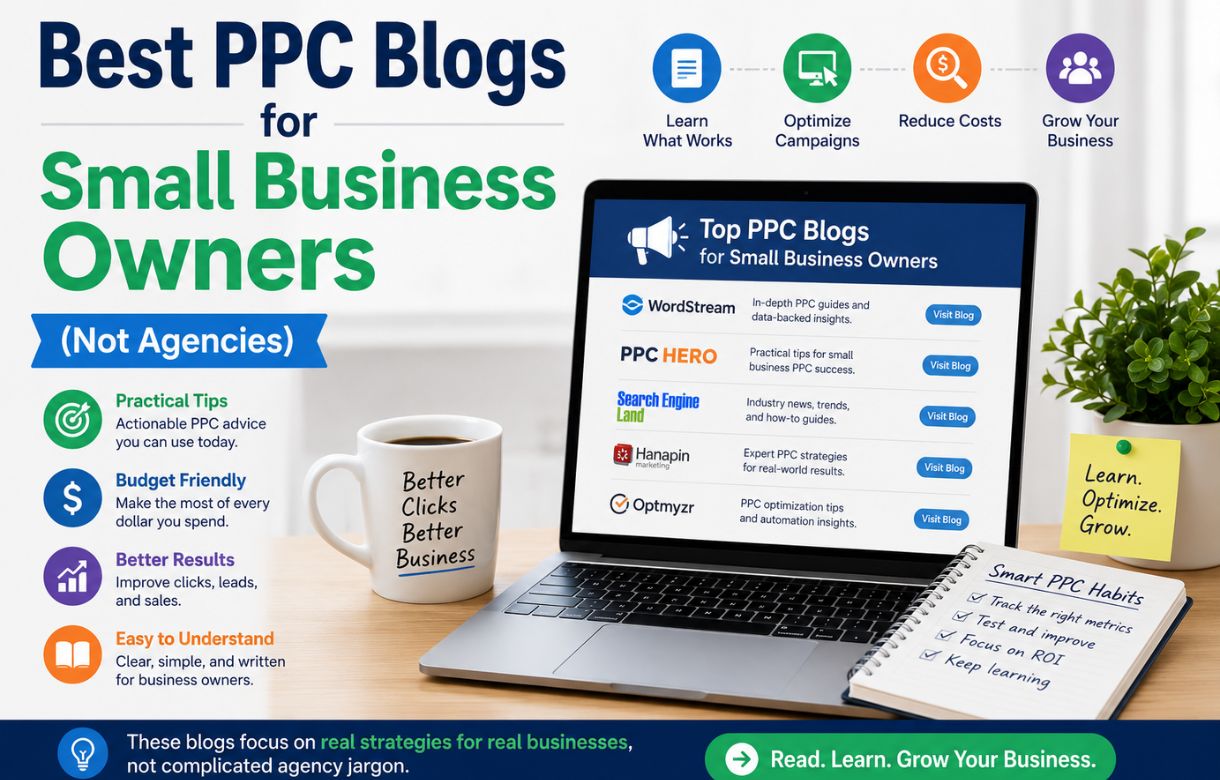
Most “best PPC blogs” lists are written for people who already do this for a living — agency account managers, in-house PPC specialists, people fluent in Quality Score math before breakfast. That’s not who’s actually searching for help most of the time. It’s usually someone running a small business who set up a Google Ads campaign last week, has no idea if $40 a day is too much or too little, and just wants to stop guessing.
That reader needs a shorter, more filtered list than the usual roundup — fewer platform-news feeds, more plain-language guidance actually written with a small budget and no dedicated marketing team in mind.
Why Do Most PPC Blog Lists Not Fit a Small Business Owner?
Because they’re written for the wrong reader. A lot of “best PPC blogs” content optimizes for volume and familiar names, which means a lot of overlap with agency-focused publications built around six- and seven-figure ad budgets, complex attribution modeling, and platform features a single-location business will genuinely never touch. None of that is wrong information — it’s just aimed at someone managing dozens of accounts, not one.
The filter that actually matters for a small business owner is different: does this blog assume you have a dedicated marketer, or that you’re doing this yourself, in between everything else you’re running the business?
Which Blogs Actually Explain PPC in Plain Language?
WordStream is the most consistently beginner-friendly of the well-known names. It’s built around practical, how-to content rather than industry commentary, and a lot of its material is written explicitly for smaller advertisers who want straightforward guidance without wading through jargon first.
Search Engine Journal covers PPC alongside SEO and broader digital marketing, and its beginner guides and checklists tend to explain concepts rather than assume you already know them — useful if you’re piecing together paid search knowledge without a formal marketing background.
Which Blog Is Best for Understanding What Google Actually Wants?
The Google Ads blog and Think with Google, straight from the source, are worth following even though they’re not written specifically for small businesses. The value here isn’t tutorials — it’s knowing what’s actually changing on the platform you’re spending money on, directly from the company running it, instead of hearing about a change secondhand through a paraphrased blog post.
Which Blog Is Best If You’re Not on Google Ads Alone?
If you’re also running Meta or other paid social alongside search, HubSpot’s marketing blog tends to connect PPC into the broader picture — how paid search fits with paid social, landing pages, and the rest of a small business’s marketing stack — rather than treating it as an isolated skill. Useful specifically because most small businesses aren’t running PPC in a vacuum; it’s one piece of a much smaller overall marketing effort.
Which Blog Actually Talks About Budget-Constrained Advertising?
This is the gap in most existing “best PPC blogs” lists. A lot of the well-known publications write from the assumption of meaningful monthly spend, which leaves a genuine hole for the business spending a few hundred to a couple thousand dollars a month. If you’re in that range, look specifically for content on PPC Hero, which — despite being agency-run — still regularly publishes tactical, campaign-structure-level posts that scale down reasonably well to smaller budgets, rather than only covering enterprise-scale strategy.
Should You Bother With PPC Blogs Focused on Landing Pages and Conversion?
Yes, and this is one of the most overlooked categories for small business owners specifically. Unbounce’s blog focuses on landing pages and conversion rate optimization rather than the ad platforms themselves — genuinely useful, because a small business is far more likely to be losing money on a weak landing page than on bad keyword targeting, and that side of PPC gets much less attention in the standard “best blogs” lists.
What Should You Skip, at Least at First?
Anything primarily focused on platform news and feature announcements — Google Ads & Commerce updates, policy change roundups, and similar feeds. These matter more once you’re managing an account day-to-day and need to react quickly to changes. Early on, they’re mostly noise: interesting to a specialist, distracting to someone still learning how Quality Score and ad rank actually work.
How Should You Actually Use These, Practically?
Pick one plain-language source (WordStream or Search Engine Journal) for learning the fundamentals properly, one direct-from-the-platform source (the Google Ads blog) for knowing what’s actually changing, and skip the rest until you’ve got a working campaign and specific questions. Following six PPC blogs at once as a small business owner with no dedicated marketing time isn’t thoroughness — it’s a good way to read a lot and act on none of it.
Frequently Asked Questions
Do small business owners need to follow PPC news closely?
Not closely, at least not at first. Major platform changes that actually affect a small campaign tend to surface through the mainstream marketing press or the platform’s own blog eventually; chasing every minor update mostly benefits agencies managing many accounts at once.
Is WordStream good for beginners specifically?
Yes — it’s one of the more consistently beginner-oriented options among the well-known PPC publications, with an emphasis on practical how-to content over industry commentary.
Should a small business owner follow agency-run PPC blogs?
Selectively. Agency blogs like PPC Hero often publish genuinely tactical content, but some material assumes larger budgets and dedicated account management. Filter for posts about campaign structure and fundamentals rather than enterprise-scale strategy pieces.
What’s more valuable for a small business: a PPC blog or a landing page blog?
Often the landing page content matters more than people expect. A small business frequently loses more money to a weak landing page than to imperfect keyword targeting, which makes conversion-focused blogs like Unbounce’s worth following alongside more traditional PPC sources.
Consider This Also:
Once you’ve picked a source or two from this list, the next question is how to actually fit them into a routine — PPC Blog vs. Newsletter vs. Community: Where Should You Actually Learn? breaks down which format to lean on depending on whether you’re learning fundamentals, staying current, or troubleshooting a live campaign. And if reading these blogs makes you want to start documenting your own small-budget PPC experiments publicly, How to Start a PPC Blog (What Actually Works, Not Just a Publishing Schedule) covers the positioning that actually gives a new blog a chance against names like these.