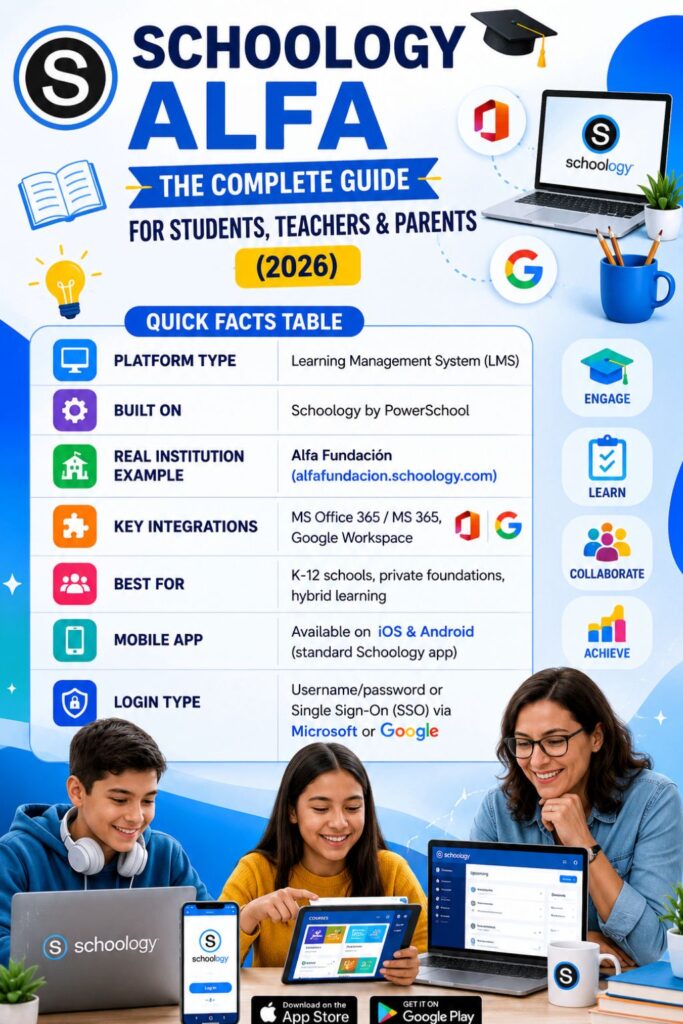
Quick Facts Table
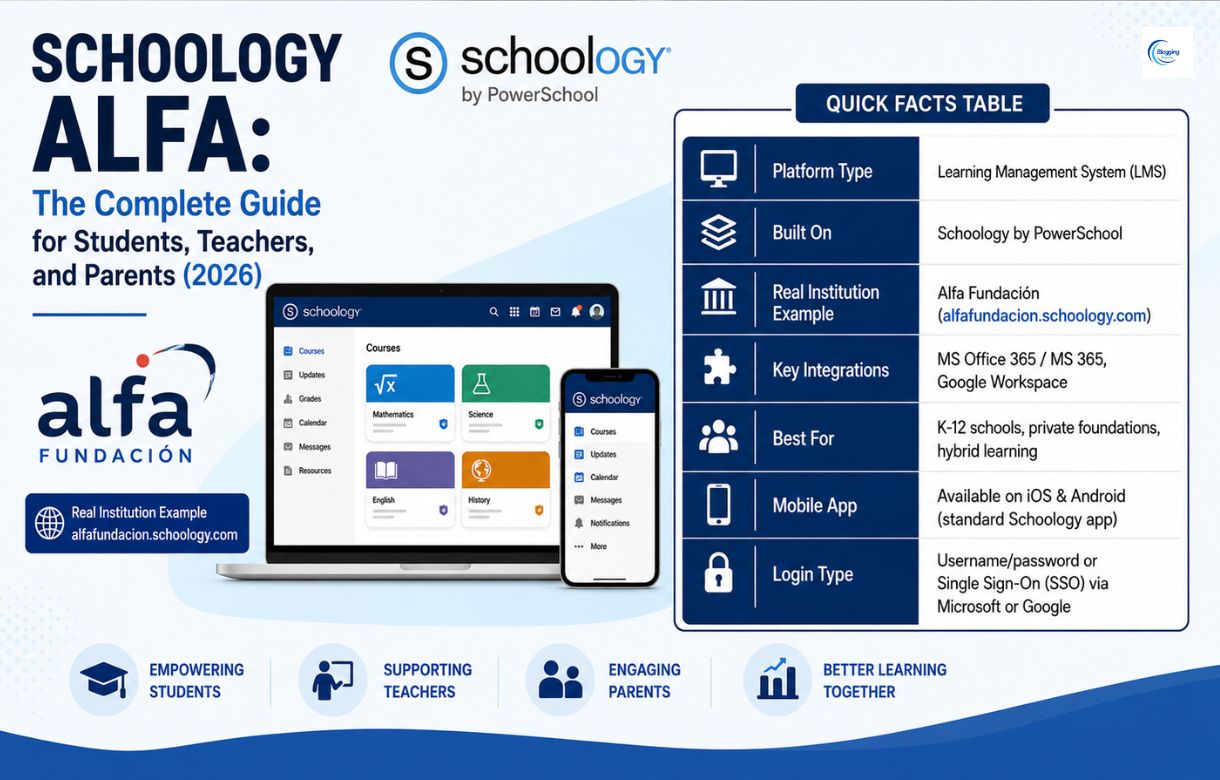
| Feature | Detail |
|---|---|
| Platform Type | Learning Management System (LMS) |
| Built On | Schoology by PowerSchool |
| Real Institution Example | Alfa Fundación (alfafundacion.schoology.com) |
| Key Integrations | MS Office 365 / MS 365, Google Workspace |
| Best For | K-12 schools, private foundations, hybrid learning |
| Mobile App | Available on iOS & Android (standard Schoology app) |
| Login Type | Username/password or Single Sign-On (SSO) via Microsoft or Google |
If you’ve recently come across the term “Schoology Alfa” and found yourself wondering what it actually means — you’re not alone. It pops up in school portals, parent emails, and student login pages with very little explanation attached. This guide breaks it all down clearly, without jargon.
Whether you’re a student trying to log in for the first time, a teacher setting up your digital classroom, or a parent trying to keep up with your child’s schoolwork — this article covers everything you need to know about Schoology Alfa in straightforward language.
What Is Schoology Alfa? The Honest Explanation
Let’s clear something up right away: Schoology Alfa is not a separate product or a different app from Schoology. It’s not sold in any app store under that name, and PowerSchool (the company that owns Schoology) doesn’t officially use “Alfa” as a product tier or brand.
So what is it?
Schoology Alfa refers to a customized, institution-branded implementation of the core Schoology LMS. In plain English — it’s what Schoology looks like when a school, foundation, or organization named “Alfa” (or “Alpha”) sets it up with their own branding, subdomain, and configuration.
The clearest real-world example is Alfa Fundación (Alfa Foundation), a Spanish-language educational institution that operates its learning portal at alfafundacion.schoology.com. Students and staff at that organization access their classes, assignments, and grades through that branded environment — which is what people are searching for when they type “Schoology Alfa” into Google.
Think of it this way: just as a hotel runs on the same booking software whether it’s called The Grand Regent or The Blue River Inn, Schoology Alfa runs the same LMS engine — just with a different institution’s name and settings on top.
A Quick Look at Schoology Itsel
Before diving deeper into the Alfa-specific side of things, it helps to understand what Schoology actually is.
Schoology is one of the most widely used Learning Management Systems (LMS) in the world, particularly across K-12 schools and school districts. Originally founded in 2009, it was acquired by PowerSchool in 2019 and has since grown into a comprehensive platform that connects students, teachers, parents, and administrators in one digital space.
The platform handles everything from lesson delivery and assignment submission to grade tracking and parent communication. It’s designed to reduce the chaos that comes from managing education across email, spreadsheets, physical handouts, and multiple disconnected apps — and largely, it succeeds at that job.
Who Uses Schoology Alfa and Why
Schoology Alfa — meaning any customized Schoology environment with “Alfa” branding — is most commonly used by:
Private foundations and non-profit schools that use education program names like “Alfa” or “Alpha” as part of their institutional identity. Alfa Fundación is a notable example, offering structured online coursework to students through its dedicated Schoology portal.
International schools and bilingual programs want a branded, localized LMS environment. Because Schoology supports custom subdomains and institutional SSO, it’s popular with organizations that operate across borders.
Any school or district where an administrator has named their Schoology environment with “Alfa” as part of their program or school branding — a naming pattern common in Latin America, Spain, and parts of Europe.
If your school has sent you a login link that starts with something like[schoolname].schoology.com, you’re accessing a customized Schoology environment, and the guide below applies to you directly.
How to Log In to Schoology Alfa: Step-by-Step
Logging into any Schoology-based portal, including Alfa-branded ones, follows the same basic process. Here’s how it works:
Step 1 — Get Your Login Credentials
Your school or organization will provide you with a username (often your school email address) and a password. If you haven’t received these, contact your teacher, class coordinator, or school IT department. They are the ones who set up student accounts — Schoology itself doesn’t assign credentials to individual students directly.
Step 2 — Go to Your School’s Specific Login URL
This is important. Don’t just search “Schoology login” and click the first result — your institution has its own custom URL. For Alfa Fundación, that’s alfafundacion.schoology.com. For other institutions, it will follow the pattern [yourschool].schoology.com.
If your school uses Single Sign-On (SSO) through MS Office 365 or Google, you may simply click “Sign in with Microsoft” or “Sign in with Google” on the login page instead of entering a separate username and password.
Step 3 — Enter Your Credentials and Log In
Type in your username and password, then click the login button. If your password isn’t working, use the “Forgot Password” option on the page — it will send a reset link to your school email.
Step 4 — Navigate Your Dashboard
Once inside, you’ll land on your personal dashboard. This is your home base. From here you can see:
- All your enrolled courses
- Upcoming assignments and their due dates
- Recent announcements from teachers
- Grades and feedback
- Messages and notifications
Everything is organized on the left-side menu. Courses, Groups, Resources, Grades — each category is one click away.
Core Features of Schoology Alfa Explained
Because Schoology Alfa is built on the core Schoology platform, it comes with the full suite of Schoology features. Here’s what that actually means for daily use:
Course Management
Teachers can build complete online course spaces with organized modules, uploaded documents, embedded videos, and external links. Students work through content in a structured sequence, which means no more hunting through email threads for the right file.
Online Assignment Submission
Students submit homework directly through the platform — typed responses, uploaded files, recorded audio, you name it. Assignments are timestamped on submission, which removes the “I sent it last night” confusion. Teachers grade and return feedback in the same space.
Quizzes and Assessments
Teachers can create timed quizzes, auto-graded multiple-choice tests, essay-format assignments with rubrics, and more. Schoology supports a range of assessment types, which makes it flexible enough for a vocabulary test or a research project alike.
Gradebook and Progress Tracking
Students can see their grades in real time, course by course. Parents connected through parent accounts can see the same. This transparency is one of the most appreciated features among families using Schoology Alfa — there are no report card surprises.
Communication Tools
Schoology includes direct messaging, discussion boards, group announcements, and course-wide updates. Teachers can send an announcement to the whole class or message a single student privately. This keeps school-related communication off personal platforms like WhatsApp and in a structured, school-appropriate environment.
Mobile App Access
Schoology has a native mobile app for both iOS and Android. Students and parents can download it, log in with their institution credentials, and access everything — assignments, grades, messages — from their phone. There is no separate “Schoology Alfa” app; the standard Schoology app is what you use, and it works with any institutional login.
Schoology Alfa and MS Office 365 / MS 365 Integration
One of the most practical aspects of using Schoology in an institutional setting is how well it connects with MS 365 (formerly MS Office 365). For schools that already use Microsoft tools, this integration removes a lot of friction.
Here’s what the Schoology and MS Office 365 integration actually provides:
Microsoft 365 LTI App — Microsoft has developed a unified Learning Tools Interoperability (LTI) app specifically for Schoology and other major LMS platforms. Once a school administrator deploys it, educators and students can access Microsoft tools directly from inside their Schoology courses — no switching between tabs or apps.
OneDrive file access — Students and teachers can attach Word documents, PowerPoint presentations, and Excel spreadsheets directly from their OneDrive to any course assignment or module. This means working on a school document in Word and submitting it through Schoology Alfa is completely seamless.
Microsoft Teams integration — The MS 365 LTI brings Teams meetings directly into Schoology course pages. Teachers can schedule a live virtual class session from within Schoology, and students launch it with a single click from the same interface they use for their coursework.
Single Sign-On with Microsoft accounts — Many schools configure Schoology to authenticate through Microsoft Entra ID (formerly Azure Active Directory), meaning students log into Schoology Alfa using the same Microsoft account credentials they use for everything else on their school device. One login, one password, everything connected.
OneNote Class Notebooks — Teachers can create shared OneNote notebooks for a class, accessible from inside Schoology. Students take notes, complete readings, and collaborate within a notebook that the teacher can also view and annotate.
For schools that have invested in the Microsoft education ecosystem, the Schoology and MS 365 pairing is genuinely coherent. The tools talk to each other rather than working in parallel silos.
How Students Can Get the Most Out of Schoology Alfa
The platform offers a lot, but like any tool, it works better when you actually use it intentionally. Here are practical tips that make a real difference:
Check your dashboard every morning. It only takes about 30 seconds to scan for new assignments, announcements, or teacher feedback. Students who do this consistently seldom miss a deadline.
Use the calendar feature. Schoology has a built-in course calendar that shows all upcoming due dates. You can also sync it with an external calendar app. If you’re juggling multiple subjects, this single feature prevents a lot of last-minute panic.
Turn on notifications. The Schoology mobile app allows push notifications for new assignments, grades, and messages. Configured well, this replaces the chaotic “did anyone hear about the homework?” group chat.
Read teacher feedback properly. When a graded assignment comes back, take a few minutes to read the comments, not just the score. This is where actual learning happens — and teachers notice when students engage with feedback.
Don’t wait until the night before. Assignment submissions in Schoology are timestamped. Teachers can see exactly when work was submitted, and late submissions are marked automatically. Getting in the habit of submitting at least a day early is both a grade protector and a stress reducer.
Schoology Alfa for Teachers: What Changes and What Stays the Same
If you’re a teacher whose school has moved to a Schoology Alfa environment, the core workflow is straightforward. The “Alfa” branding changes the URL and possibly the color scheme of your portal — it doesn’t change how courses, assignments, and grades work.
What tends to change for teachers in institutional Schoology environments:
Course templates may be pre-configured. Your school administrator may have set up course structures, grading scales, or category labels in advance. This is a time-saver, not a restriction — it means less setup work per class.
SSO and integration settings are handled at the admin level. If your school uses MS Office 365, your IT administrator deploys the Microsoft LTI integration once, and it’s available to all teachers in the organization. You don’t manage that yourself.
Communication tools may follow institutional guidelines. Large organizations using Schoology Alfa often configure communication permissions carefully — for example, limiting who can initiate conversations with students. These guardrails exist for safeguarding reasons.
What doesn’t change: creating courses, uploading materials, writing assessments, giving feedback, tracking grades, communicating with students and parents. All of that works identically to standard Schoology.
Schoology Alfa vs Standard Schoology: Is There a Real Difference?
Practically speaking, no, not in the way that matters for day-to-day use.
The table below summarizes the comparison clearly:
| Aspect | Standard Schoology | Schoology Alfa |
|---|---|---|
| Core LMS features | Full | Full (identical) |
| Login URL | app.schoology.com or custom | [institution].schoology.com |
| Branding | Schoology default | Institution-specific |
| SSO support | Available | Available (often configured by default) |
| MS 365 integration | Optional, admin-configured | Optional, admin-configured |
| Mobile app | Schoology iOS/Android | Same Schoology iOS/Android app |
| Cost to students | Free (covered by institution) | Free (covered by institution) |
The “Alfa” in Schoology Alfa is an institutional label, not a product tier. Students are accessing the same LMS as students in a U.S. public school district who log into it lausd.schoology.com. The engine is the same. The classroom furniture has a different logo on it.
Common Login Problems and How to Fix Them
Even when everything is set up correctly, a few issues come up repeatedly. Here’s how to handle the most common ones:
“Your credentials are incorrect,” or login fails repeatedly. Double-check that Caps Lock is off and that you’re using the right email format (some schools use firstname.lastname@school.edu, others use a student ID number). If you’re certain the details are right and it still fails, use the password reset option or contact your school’s IT helpdesk — not Schoology support, which handles platform issues rather than individual account access.
You can’t find your school’s login page. Your school should have provided a direct URL. If you’ve lost it, search for your school’s official website and look for a “Student Portal” or “LMS” link. Alternatively, ask a classmate or teacher for the exact URL.
The page loads, but the dashboard is empty. This usually means your teacher hasn’t enrolled you in any courses yet, or your account was just created and course enrollment is still being processed. Give it a day, and if nothing appears, message your teacher directly.
The MS 365 / OneDrive integration isn’t working This is typically an admin-level configuration issue, not something students can fix themselves. Report it to your school’s IT department with a description of what error message you’re seeing.
Schoology Alfa and the Future of Digital Learning
The growth in platforms like Schoology Alfa reflects a genuine shift in how education is delivered — not a temporary pandemic workaround, but a long-term structural change.
Hybrid learning (part in-classroom, part remote) is now the norm in many schools globally. Learning management systems are the infrastructure that makes this possible. As AI tools, personalized learning analytics, and better mobile experiences continue to develop, Schoology is building those capabilities into the platform through PowerBuddy — its AI assistant — and expanding its integrations with tools like MS 365.
For institutions like Alfa Fundación and others operating branded Schoology environments, this matters a lot. They’re not just using a digital gradebook — they’re managing a complete educational ecosystem, and the tools they’ve adopted are built to grow with them.
Students who develop fluency with platforms like Schoology Alfa are also building practical digital literacy skills — navigating structured platforms, managing digital deadlines, communicating professionally online — that carry over well beyond school.
Final Thoughts
Schoology Alfa isn’t a mystery product or an obscure piece of education tech — it’s simply what happens when an institution named “Alfa” (or similar) builds their digital classroom on top of the Schoology LMS. If your school uses it, you’re working with one of the most capable and widely deployed educational platforms in the world.
The login process is straightforward, the features are well-designed for both teachers and students, and the integration with tools like MS Office 365 makes it genuinely powerful for schools already in the Microsoft ecosystem.
The best thing you can do as a student is log in regularly, set up notifications, and use the calendar feature. The best thing a teacher can do is take an hour to explore the course builder before the term starts. And the best thing parents can do is activate their parent account and check in once a week.
Once you understand what it is and how it works, Schoology Alfa stops being confusing and starts being genuinely useful — which is exactly what a learning platform should be.
Frequently Asked Question
Is Schoology Alfa a separate app from Schoology?
No. There is no standalone “Schoology Alfa” app. It’s a customized Schoology environment used by institutions with “Alfa” in their name. You use the standard Schoology app to access it.
Where do I get my Schoology Alfa login credentials?
Your school or institution provides them. Schoology itself does not assign student accounts — your teacher, program coordinator, or IT department does.
Can I log in to Schoology Alfa using my Microsoft account?
If your school has configured SSO through MS Office 365 (MS 365), yes. You’ll see a “Sign in with Microsoft” option on the login page. This uses your existing school Microsoft account credentials.
Is Schoology Alfa free for students?
Yes. Students don’t pay anything to use it. The institution holds the Schoology license and covers the cost. Students, parents, and teachers access it at no direct charge.
Can parents access Schoology Alfa?
Yes. Schoology supports parent accounts. Parents receive an access code from the school to create an account that links to their child’s profile, where they can view grades, assignments, and teacher communications.
What’s the difference between Schoology Alfa and Schoology Plus?
Schoology Plus is an official paid plan offered by PowerSchool with additional premium features. Schoology Alfa is simply an informal or institution-specific name for a branded Schoology deployment — it’s not an official paid tier.
I searched “Schoology Alfa” and found Poki — is that related?
No. Poki is an online gaming platform with no connection to Schoology. The two appear together in search results occasionally due to broad keyword overlap, but they serve entirely different purposes. Schoology Alfa is an educational LMS; Poki is a browser gaming site.