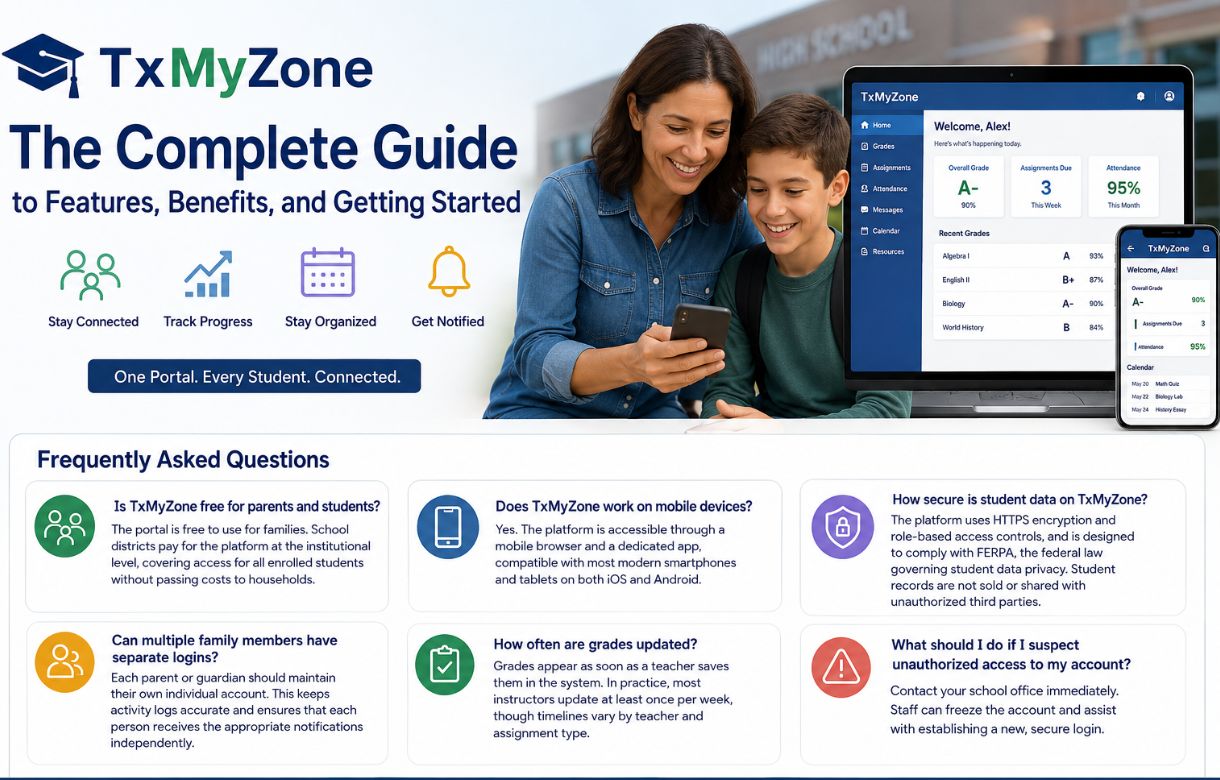
There is a quiet but persistent frustration built into the life of most school families: information is always somewhere else. Grades live on one platform, attendance on another, school announcements come through email, and payment reminders arrive by paper in the bottom of a backpack. TxMyZone was built as an answer to exactly that problem — a centralized digital portal designed to bring the full picture of a student’s academic life into one secure, accessible place.
Whether you are a parent trying to stay involved, a student managing a packed academic schedule, or a teacher looking to cut hours of administrative overhead, understanding what TxMyZone offers — and how to use it well — can meaningfully change how you experience the school year.
What Is TxMyZone?
TxMyZone is a centralized educational management system used by school districts to organize student data and streamline communication between classrooms and households. It serves as a digital bridge between the school and the home, giving students, parents, and teachers real-time access to the academic and administrative information that actually drives day-to-day decisions.
At its core, the platform functions as a unified school portal where each user logs in to a role-specific dashboard. Rather than building another generic communication tool, TxMyZone was designed around the actual rhythms of K-12 education — grading cycles, attendance records, fee payments, and the continuous flow of assignments and announcements.
The growing demand for integrated solutions has made platforms like TxMyZone increasingly valuable. Instead of managing multiple disconnected tools, users access every key function from a single system. That consolidation is the platform’s central value proposition: one login, one dashboard, one source of truth for everything that matters in a student’s academic life.
How TxMyZone Works
The platform operates on a cloud-based architecture, meaning data is stored securely and is accessible from any internet-connected device. When a teacher enters a grade, the system automatically pushes that update to the student and parent views. Payments for lunches or field trips move through a secure gateway directly to the school’s account.
What makes this architecture particularly effective is the role-based access model. The system reads your login credentials to determine what you can see. Students see their own coursework and scores. Parents see their children’s progress. Teachers access tools to manage and communicate with entire classes. This is not just a convenience feature — it is a meaningful privacy safeguard that ensures sensitive student records never surface in the wrong hands.
The platform is built around a main dashboard that connects separate modules for grading, attendance, and finance. Each module functions like a dedicated app within the same portal, creating a smooth experience without the need to toggle between external systems.
Key Features Worth Knowing
Real-Time Grade and Attendance Tracking
The most immediate benefit for most families is visibility. Users receive instant alerts when a new grade is posted, eliminating the waiting period that once kept students and parents in the dark about academic standing. For parents, the ability to check attendance remotely — without calling the school office — is a practical shift that removes daily uncertainty.
Calendar and Assignment Management
A built-in calendar displays every upcoming test and project deadline, helping students plan study time and avoid the last-minute scramble that tends to define less organized school weeks. The calendar integrates directly with the assignment tracker, so items are connected to the class they belong to and the teacher who assigned them, rather than appearing as a disconnected list.
Centralized Messaging
Teachers can send direct messages to individual parents or broadcast announcements to the entire class. All school communication is consolidated in one secure space rather than scattered across personal email inboxes. Critically, teachers can confirm message receipt, so there is no more uncertainty about whether the permission slip reminder actually reached every household.
Fee and Payment Processing
One of the more underappreciated features is the integration of school financial transactions. Lunch accounts, field trip fees, and activity charges can all be managed directly through the portal, eliminating the cash-in-an-envelope routine that still persists in many districts.
Single Sign-On and Cross-Device Access
One set of login credentials provides access across phones, tablets, and laptops, with the interface automatically adjusting to fit the screen being used. This matters particularly for parents who check in from a workplace computer during the day and a mobile device in the evening.
Why TxMyZone Matters for Students
Students are the most direct beneficiaries of the transparency TxMyZone creates. Rather than waiting for a formal report card, they can see scores as soon as a teacher saves them — which means they can identify a problem and ask for help long before a final exam makes it consequential.
That real-time visibility reshapes how students relate to their own academic performance. A quiz result that would have been invisible for weeks under the old paper-based model now surfaces the same afternoon, giving students the information they need to make a decision: study independently, seek extra help, or speak with the teacher before the next assessment.
The assignment consolidation is equally valuable, particularly at the secondary level. Study guides, feedback notes, and class resources live in a single dashboard rather than scattered across notebooks, lost handouts, and unreliable memory — the combination that tends to define the organizational systems of most middle and high school students.
Why TxMyZone Matters for Parents
The parental view is where TxMyZone has perhaps its deepest long-term impact. Parents who previously felt at arm’s length from their child’s education — whether because of demanding work schedules, language barriers, or simply not knowing what questions to ask — gain the same real-time visibility as the most engaged classroom volunteer.
Shared calendar access changes the nature of conversations at home. When both parent and student can see the same assignment list and deadline calendar, the question shifts from the vague “Do you have homework tonight?” to something far more specific and actionable. That shared accountability is one of the quieter but more significant things the platform enables.
Parents who feel genuinely connected to their child’s academic life are also more likely to step in early when difficulties arise, rather than discovering a problem at the semester’s end when the window for intervention has already closed.
Why TxMyZone Matters for Teachers
From the instructor’s side, the platform is fundamentally a time-recovery tool. The digital gradebook calculates averages automatically, eliminating manual math errors and the time spent maintaining paper records. Teachers can post digital assignments that students submit directly through the portal, cutting the friction out of the collection and return cycle.
Message engagement tracking adds another layer of accountability to communications. Rather than sending a class announcement into the void and hoping it reaches everyone, teachers can see exactly who has and hasn’t read it — information that is useful for everything from event planning to following up with families who may need more direct outreach.
For school administrators, the reporting tools round out the picture. Attendance trend reports and class average summaries are generated in a few clicks, giving school leaders the data they need to make informed decisions about where support and resources should be directed.
TxMyZone vs Other Platforms
Understanding where TxMyZone sits relative to the broader ecosystem of educational tools helps clarify what it is actually built to do.
TxMyZone vs Google Classroom. Google Classroom excels at the mechanics of assignment delivery and document collaboration, but it was not built for the administrative record-keeping that families most need — attendance histories, official grade records, transcript data, and fee management. Most schools that deploy TxMyZone use Google Classroom alongside it, with each tool handling the layer it was designed for.
TxMyZone vs Blackboard or Canvas. These platforms were built for higher education and carry the complexity that the environment demands. TxMyZone is architecturally simpler and purpose-built for K-12 families. The distinction matters: a college student navigating a Canvas course management system is a fundamentally different user from a parent of a seventh-grader who needs to verify a grade before dinner.
TxMyZone vs email. Email remains the fallback in many districts, and it consistently underperforms. Messages are missed, threads get buried, and there is no mechanism to confirm that any given communication actually reached its intended recipient. TxMyZone replaces that unreliable chain with a searchable, time-stamped, receipt-confirmed communication layer.
Getting Started: A Practical Guide
Find your school’s login URL. Each district operates its own instance of the portal with a unique web address. Check your school’s official website under a “Parents,” “Families,” or “Portal” tab. If you cannot locate it, the school office can provide the direct link.
Register with the right credentials. Most districts require a Student ID or Portal Key to connect a new account to the correct student record. Have those on hand before starting the registration process — the system cannot link your profile to the right data without them.
Verify your contact information immediately. Before exploring the dashboard, confirm that your email address and phone number are correctly entered in your profile settings. Notification delivery depends entirely on accurate contact information, and errors here are easy to miss until you realize you have not received any alerts.
Configure your notifications thoughtfully. The default notification settings are a starting point, not a prescription. Most users find it useful to enable push notifications for grade updates and direct messages while setting attendance alerts to email to avoid midday interruptions.
Start with the Grades and Calendar tabs. These two sections deliver the majority of the platform’s day-to-day value. Becoming comfortable with their layout in the first week will make the rest of the term significantly easier to navigate.
Security and Privacy
TxMyZone handles sensitive student data, and its security architecture is designed accordingly. HTTPS encryption protects data in transit, scrambling information so that it cannot be read by unauthorized parties. Combined with the role-based access model, this means private academic records remain genuinely private — a student cannot see another student’s grades, and an unauthorized adult cannot access a child’s record.
The platform is built to comply with FERPA — the Family Educational Rights and Privacy Act — which sets the federal standard for how schools must handle student information. That compliance is a meaningful baseline: it means the platform is not selling student data, sharing records with third parties without authorization, or treating educational information as a commodity.
Practically, users can strengthen their own account security by using a unique password not shared with other sites, enabling any available two-factor authentication, and contacting the school office immediately if they notice login activity they do not recognize.
Common Problems and How to Resolve Them
Cannot log in. The first check is always whether Caps Lock is active — passwords are case-sensitive. If the password itself is lost, the “Forgot Password” link on the login screen will send a reset code to your registered email address.
Grades appear missing. Most teachers update the portal at least once a week, but many wait until they have finished marking an entire class set before uploading scores. If a student has been absent for more than seven days after an assignment’s due date, a polite message to the teacher through the portal is the appropriate next step.
Notifications not arriving. Check the system-level permissions on your phone — the portal app requires explicit permission to send alerts. Also verify that the email address in your profile does not contain a typo, which is a more common cause of missing notifications than most users expect.
Mobile and desktop experience differences. The mobile app is well-suited to quick daily check-ins, but the full desktop interface offers more functionality for tasks like printing reports or navigating administrative settings. If a feature appears missing on a mobile device, the desktop version is the right place to look.
Advanced Tips for Getting the Most Out of TxMyZone
Once the basics are in place, a few additional habits significantly increase the platform’s usefulness.
Filter the calendar by assignment type. Most versions of the portal allow users to display only tests, only homework, or only specific classes. This makes it far easier to identify the next high-stakes event without scrolling through a dense list of minor daily tasks.
Set grade threshold alerts. Rather than receiving a notification for every individual score, configure the system to alert you only when a grade falls below a target percentage. This reduces notification fatigue while ensuring that nothing genuinely concerning goes unnoticed.
Use the semester view for longer-range planning. The semester-level calendar view shows when midterms and finals fall, which is particularly useful in households managing multiple children across different grade levels. Mapping those dates onto a shared home calendar early in the term helps the whole family prepare rather than react.
Treat the messaging inbox as a primary channel. The platform’s value as a communication hub depends on users engaging with it regularly, not treating it as a secondary backup to personal email. Teachers who use TxMyZone’s messaging system rather than personal email are choosing a more secure and accountable tool — the appropriate response is to check it with the same frequency as a standard inbox.
The Broader Picture
The gap between a school that sends home paper newsletters once a month and one where every parent can check in on their child’s academic progress in real time is not a small one. It is a gap measured in early interventions that happen versus problems that fester quietly until report card season. In the relationship quality between families and the institutions responsible for educating their children. In a student’s sense of being seen and supported rather than evaluated in isolation.
TxMyZone sits firmly on the right side of that gap. The families and educators who use it well consistently report that it changes not just how they manage information, but how connected they feel to the actual work of learning. For a school portal, that is a meaningful outcome.
Frequently Asked Questions
Is TxMyZone free for parents and students?
The portal is free to use for families. School districts pay for the platform at the institutional level, covering access for all enrolled students without passing costs to households.
Does TxMyZone work on mobile devices?
Yes. The platform is accessible through a mobile browser and a dedicated app, compatible with most modern smartphones and tablets on both iOS and Android.
How secure is student data on TxMyZone?
The platform uses HTTPS encryption and role-based access controls, and is designed to comply with FERPA, the federal law governing student data privacy. Student records are not sold or shared with unauthorized third parties.
Can multiple family members have separate logins?
Each parent or guardian should maintain their own individual account. This keeps activity logs accurate and ensures that each person receives the appropriate notifications independently.
How often are grades updated?
Grades appear as soon as a teacher saves them in the system. In practice, most instructors update at least once per week, though timelines vary by teacher and assignment type.
What should I do if I suspect unauthorized access to my account?
Contact your school office immediately. Staff can freeze the account and assist with establishing a new, secure login.
Is TxMyZone free for parents and students?
The portal is free to use for families. School districts pay for the platform at the institutional level, covering access for all enrolled students without passing costs to households.
Does TxMyZone work on mobile devices?
Yes. The platform is accessible through a mobile browser and a dedicated app, compatible with most modern smartphones and tablets on both iOS and Android.
How secure is student data on TxMyZone?
The platform uses HTTPS encryption and role-based access controls and is designed to comply with FERPA, the federal law governing student data privacy. Student records are not sold or shared with unauthorized third parties.
Can multiple family members have separate logins?
Each parent or guardian should maintain their own individual account. This keeps activity logs accurate and ensures that each person receives the appropriate notifications independently.
How often are grades updated?
Grades appear as soon as a teacher saves them in the system. In practice, most instructors update at least once per week, though timelines vary by teacher and assignment type.
What should I do if I suspect unauthorized access to my account?
Contact your school office immediately. Staff can freeze the account and assist with establishing a new, secure login.