If you’ve noticed your outreach getting quieter this year, you’re not imagining it. Cold email reply rates for SEO pitches have reportedly fallen from around 3% in 2021 to a fraction of a percent today, meaning a $2,500-a-month retainer pitch now needs tens of thousands of sends just to book a single meeting. And yet the SEO industry itself hasn’t shrunk — the global market for SEO services is valued at over $100 billion this year and climbing. So what’s actually going on? The clients haven’t disappeared. The old ways of reaching them have.
This isn’t another “SEO is dying” think piece. SEO is very much alive — what’s dying is the client-acquisition playbook agencies have leaned on for the last decade. Here’s what’s replacing it, and how to position your agency so you’re not competing on a battlefield that no longer exists.
Is the Market Actually Shrinking, or Just the Old Channels?
It’s worth separating two different questions that tend to get tangled together: is demand for SEO shrinking, and is it harder to reach that demand? The data suggests the second is true, not the first.
Search interest around specific service niches tells the real story. Terms like ecommerce SEO agency and enterprise SEO agency continue to pull meaningful monthly search volume, which tells you something important: businesses are still actively looking for specialized help; they’ve just gotten pickier about who they hire. An ecommerce brand burned by a generalist agency isn’t giving up on SEO — they’re searching more specifically for someone who understands product feed optimization, category page architecture, and marketplace search behavior. Same story on the enterprise side, where buyers are searching for agencies that can handle multi-site, multi-market complexity rather than a one-size-fits-all package.
In other words, demand hasn’t evaporated. It’s consolidated around specificity. Generalist positioning is what’s losing ground, and that shift is exactly what’s making outreach feel so much harder for agencies that haven’t repositioned.
Why the Old Playbook Stopped Working
Cold email used to be a numbers game: blast enough inboxes, book enough calls, close enough deals. That math doesn’t hold anymore. Deliverability crackdowns from major email providers, combined with sheer volume fatigue from AI-generated outreach flooding every inbox, have gutted response rates across the board.
Capability decks — the classic “here’s who we are, here’s our services” PDF — lose almost every pitch now, because they ask the prospect to imagine value instead of showing it. What’s replacing the cold pitch is narrower and more evidence-based: a short recorded walkthrough of two or three specific, fixable problems on a prospect’s actual site, sent with no ask attached beyond a conversation. It’s slower per-lead than mass email ever was, but it converts at a rate the old model simply can’t match anymore.
There’s also an overlooked channel hiding in plain sight: freelance marketplaces. The front page of platforms like Upwork is a race to the bottom on price, dominated by $50 audits and no long-term value. But agencies that dig one layer deeper — filtering into specific technical or local SEO categories, bidding inside narrow lanes, replying within a couple of hours — are finding real retainer clients there, simply because most competitors never bother to look past page one.
What’s Actually Winning Clients in 2026
A few patterns recur among agencies that are still growing their client base.
The first is proof over promises. Ranking your own agency site for the terms your ideal clients search — whether that’s a local variation or something like ecommerce SEO agency — does double duty. It generates inbound leads, and it silently demonstrates competence before a prospect ever gets on a call. If you can’t rank your own pages, why would a client trust you with theirs? And the same competitive research that helps you find those terms is worth turning on prospects, too — pulling the keywords a prospective client’s competitors already rank for is one of the fastest ways to walk into a pitch with something concrete to show them.
The second is niching down instead of broadening out. Agencies specifically chasing the enterprise SEO agency segment are finding that longer sales cycles are offset by larger, stickier retainers — the opposite of the small-business volume game most agencies default to.
The third is referrals timed intentionally rather than left to chance. The highest-converting new business still comes from existing clients, but the ask works best right after a visible win — a ranking jump, a traffic milestone — not buried in an invoice email months later.
Key Facts · Client Acquisition, 2026
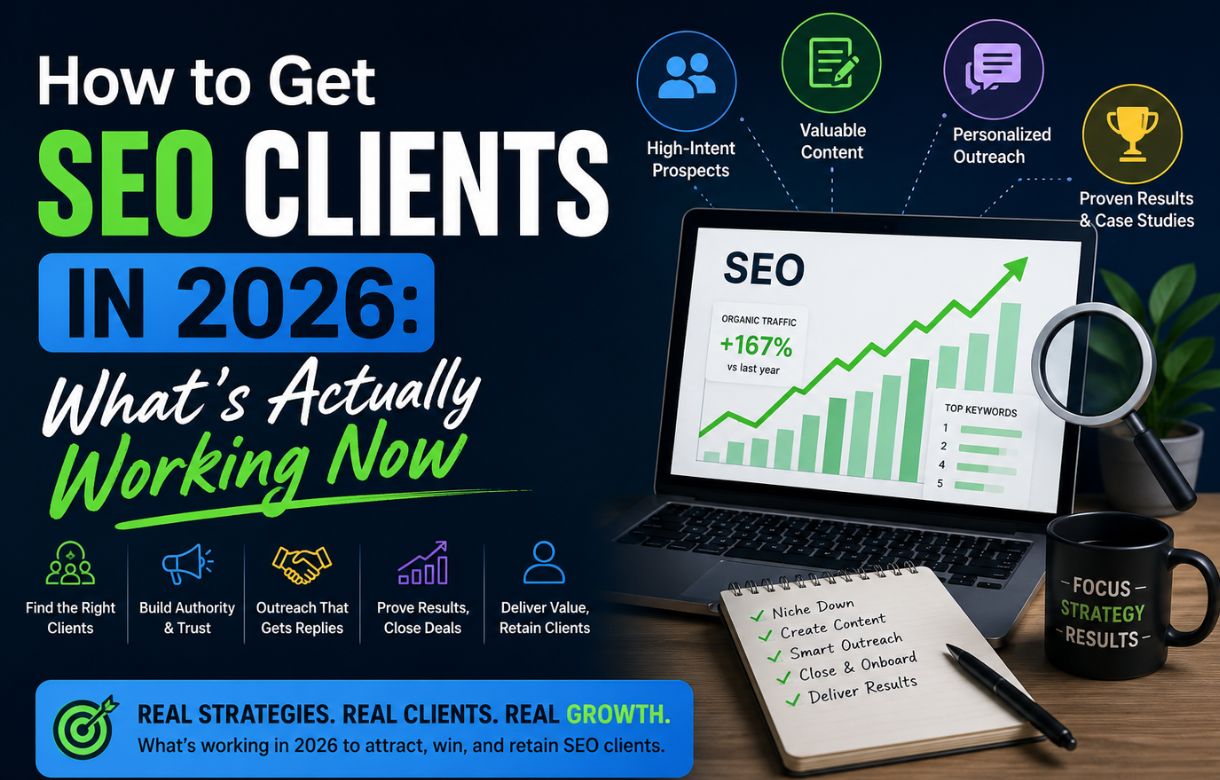
How to Get SEO Clients in 2026
What’s actually working now, in numbers
Why acquisition feels harder
- Cold email has collapsed as a channel. Deliverability crackdowns and AI-blast fatigue mean a single retainer pitch can now need tens of thousands of sends to book one meeting.
- Capability decks no longer close deals. Generic “here’s who we are” pitches ask prospects to imagine value instead of demonstrating it upfront.
- Demand hasn’t shrunk — it’s concentrated. Searches for niche terms like “ecommerce SEO agency” and “enterprise SEO agency” hold steady volume, showing buyers want specialists, not generalists.
What’s winning clients now
- Short, specific audits beat broad pitches. A quick recorded walkthrough of 2–3 fixable issues on a prospect’s actual site converts far better than a capability deck.
- Ranking your own site is proof, not marketing. An agency visible for the terms its ideal clients search demonstrates competence before a call ever happens.
- Niche marketplaces reward specificity. Real retainers exist one layer past the race-to-the-bottom front page — found via narrow category filters, not broad browsing.
- Referrals convert best right after a win. Timing the ask to a visible ranking jump or traffic milestone outperforms waiting until invoice time.
How SEO Itself Is Changing in 2026
Understanding why client acquisition feels different also means understanding what’s happening to search itself. A few questions come up constantly from clients and prospects alike.
Does SEO Still Matter for Businesses in 2026?
Yes, unambiguously. Organic search still drives roughly half of all website traffic for the average site, and the SEO services market is valued at over $100 billion this year, with continued growth projected. What’s changed isn’t whether SEO matters — it’s which version of SEO delivers results. Thin, keyword-stuffed content built purely to rank has lost value, while expertise-driven, well-researched content is performing better than it has in years, simply because it’s harder to fake and increasingly scarce online.
What’s Different About Search This Year?
The biggest shift is the move from rankings as the only success metric to visibility across multiple surfaces. AI Overviews now appear on a substantial share of Google searches, and when they show up, they measurably reduce clicks to the traditional blue links below them — some studies put the click-through drop at over 50% for the usual top spot. That’s pushed the discipline toward what’s often called answer-engine optimization: structuring content so it can be cited inside an AI-generated summary, not just ranked underneath one. Brands that do get cited inside these summaries are actually seeing a click-through boost rather than a loss, which is the detail most “SEO is dead” takes miss entirely.
What Actually Moves Rankings This Year?
Technical fundamentals — page speed, crawlability, structured data — remain table stakes, not differentiators. What actually moves rankings now is demonstrated experience: original data, first-person case studies, and content that shows rather than tells. Google’s guidance has increasingly folded these E-E-A-T signals directly into its core ranking systems rather than treating them as a side classifier, meaning genuine expertise is no longer optional polish — it’s infrastructure.
What Do the Numbers Actually Show?
A few figures worth knowing: the top three organic results still capture more than half of all clicks on a typical results page. Content over 3,000 words continues to outperform shorter posts by a wide margin in both traffic and backlinks earned. Meanwhile, a majority of Google searches now end without any click at all, largely due to AI-generated summaries answering the query directly on the page. And despite all of that disruption, the median return on SEO investment remains extremely strong compared to most other marketing channels.
The Bottom Line for Agencies
The agencies struggling to find clients in 2026 usually aren’t struggling because SEO stopped working — they’re struggling because they’re still running a 2021 acquisition strategy against a search landscape and buyer behavior that have both moved on. The fix isn’t more volume. It’s sharper proof, narrower positioning, and a pitch that shows you understand where search is actually headed, not just where it’s been.
FAQ’s
Will businesses keep investing in SEO in 2026?
Yes. Organic search still drives roughly half of all website traffic industry-wide, and the global SEO services market is valued at over $100 billion this year.
What’s changed most about search this year?
The focus has shifted from pure rankings to multi-surface visibility, as AI Overviews now appear on a large share of searches and change how — and whether — users click through to websites at all.
What helps a site rank better right now?
Technical fundamentals remain necessary but no longer sufficient. What moves rankings now is demonstrated expertise — original research, first-person case studies, and content built around genuine experience rather than keyword volume alone.
What do this year’s search data trends show?
Key figures include the top three organic results capturing over half of all clicks, a majority of searches ending without any click due to AI summaries, and SEO continuing to deliver one of the strongest returns of any marketing channel