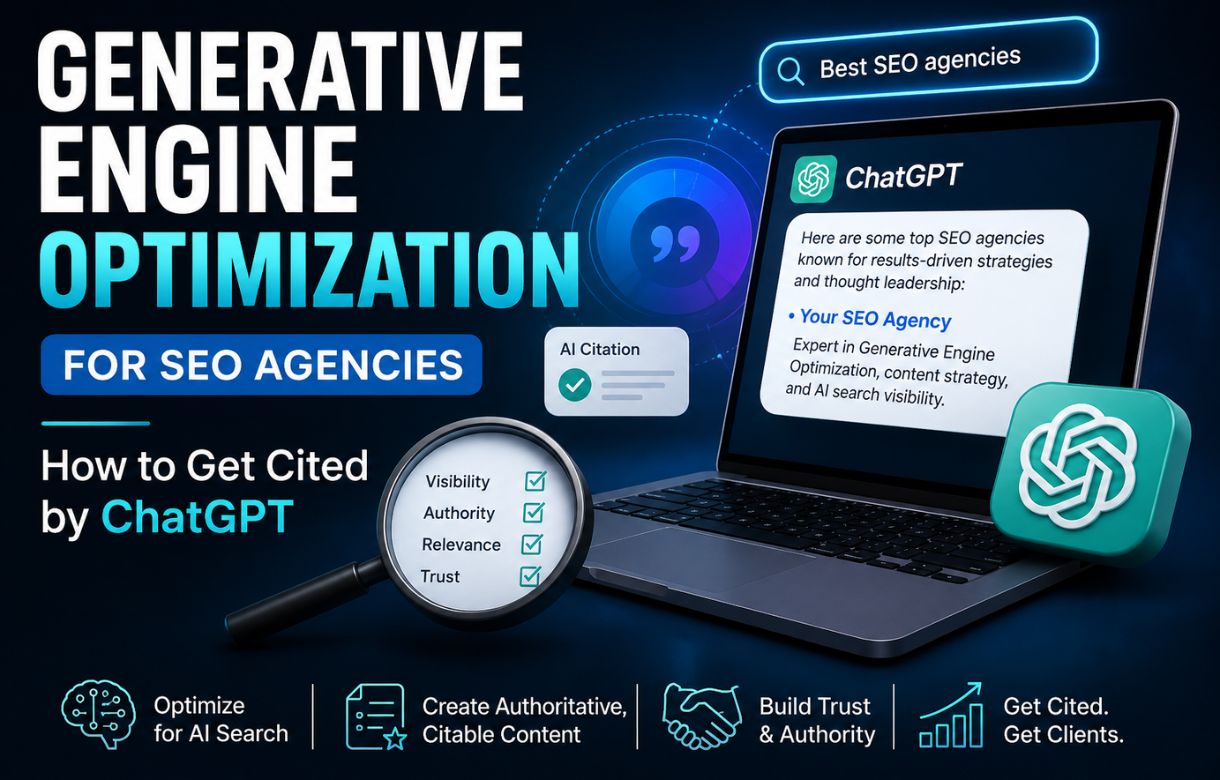
Here’s an uncomfortable number for anyone running an SEO agency in 2026: the overlap between the pages ranking on page one of Google and the sources AI engines actually cite has fallen from roughly seventy percent to under twenty. Read that again. Ranking your client at the top of Google no longer means their content is showing up when someone asks ChatGPT, Perplexity, or Gemini the same question.
That gap is where this article lives.
Most of what’s been written about generative engine optimization is aimed at brands trying to protect their own visibility. Fine, but agencies aren’t brands. We’re the ones fielding the “Are we in AI Overviews yet?” question from a client on a Tuesday call with no good answer prepared. This isn’t a definitions piece. It’s the practical version — what GEO actually means for the agency side of the business, and what you can put in front of a client this week.
Why This Is an Agency Problem, Not Just a Brand Problem
Clients don’t care about the mechanics of large language models. They care about one thing: whether my business showing up when people ask questions in the tools they now use instead of typing into a search bar. And increasingly, they’re the ones bringing it up first, not the agency.
That shift matters for how agencies position themselves. GEO isn’t a future service line to plan for someday. It’s already a conversation happening in client meetings right now, and whoever has a real answer — not a vague “we’re monitoring the AI space” answer — has a genuine edge over competitors still selling last decade’s playbook.
There’s also a retention angle here that doesn’t get talked about enough. A client who sees their competitor getting cited in ChatGPT while they’re invisible is a client who starts shopping around. Being able to explain why that’s happening, and having a plan to close the gap, is as much a retention tool as it is a pitch tool.
What Actually Changed Between SEO and GEO
Quick version, because you don’t need the full lecture: traditional search matches keywords to pages and ranks them. Generative search works differently. When someone asks an AI a question, the model doesn’t run one search — it generates a cluster of related queries behind the scenes, pulls from dozens of sources across that cluster, and stitches together an answer with citations attached.
That’s the part that trips up agencies still thinking in single-keyword terms. You can’t optimize one page for one phrase and expect an AI engine to notice. The model is evaluating your brand against a much wider set of questions than any one visitor would ever type, which means comprehensive topic coverage now matters more than it used to, not less.
The other shift worth sitting with: AI engines pull heavily from places that aren’t your website. Reddit threads, YouTube videos, Wikipedia, G2 reviews, LinkedIn posts — these show up as cited sources constantly. If your entire GEO plan for a client begins and ends with their own blog, you’re already missing most of the surface area these models are actually reading.
The Signals That Actually Move the Needle
Here’s where it gets useful instead of theoretical. Researchers from Princeton, Georgia Tech, the Allen Institute for AI, and IIT Delhi ran a study testing optimization tactics across ten thousand queries in twenty-five domains, then measured the visibility lift each tactic produced. The results give agencies something to actually act on instead of guessing.
The Four Tactics With the Biggest Measured Lift
- Direct quotations — roughly a 40% lift in visibility
- Statistics — around a 30% lift
- Citing outside sources within the content — close to a 30% lift
- Fluency and readability of the writing itself — close to a 30% lift
None of that requires a new content strategy from scratch. It requires going back through existing client content and asking: does this page quote an expert, cite a stat, reference outside sources, and read cleanly? If the answer is no across the board, that’s your starting checklist.
Recency matters too, and more than most agencies assume. Content published or meaningfully updated within the last two years shows up disproportionately more often in AI-generated answers. A cornerstone page a client hasn’t touched since 2023 is quietly losing ground to newer content saying the same thing, even if the older page still ranks fine on Google.
A GEO Audit You Can Actually Run This Week
This is the part the bigger publications skip, because they’re writing for a general audience instead of people who bill hours. Here’s a checklist an agency can run on a client site without needing new tools or a research team.
Step 1: Access
Check the site’s robots.txt file to confirm AI crawlers aren’t being blocked outright — an easy thing to overlook, and a silent GEO killer if it’s happening. Confirm important content isn’t hidden behind JavaScript rendering that only shows up after interaction, since some AI crawlers won’t execute it the way a browser does. Make sure nothing client-facing and valuable sits behind a login wall or paywall that would keep it invisible to a model doing retrieval.
Step 2: Structure
Add or clean up FAQ schema on pages where it’s missing — this is one of the more reliable ways to help an AI system lift a direct answer out of a page. Check heading hierarchy: one clear topic per H2, with the direct answer stated before the surrounding context, not buried three paragraphs in. Generative engines favor content that gives them the answer up front and the explanation after, which is basically the inverse of how a lot of SEO content still gets written.
Step 3: Freshness
Pull a list of the client’s highest-traffic evergreen pages and flag anything untouched in over a year. Even a light pass — updated stats, a new example, a changed “last updated” date — measurably improves how often that page gets pulled into AI answers.
None of this replaces a full SEO strategy. It sits on top of one, and it’s something you can walk a client through on a single call.
Pitching GEO Without Overpromising
Here’s where a lot of agencies are going to get this wrong in 2026: selling GEO as a fully measurable, guaranteed-results service the way search rankings used to be sold. It isn’t there yet, and pretending otherwise is how agencies end up with client relationships built on numbers nobody can actually verify.
Be upfront about that gap. Tracking AI citation frequency is possible but nowhere near as mature as a Google Analytics dashboard, and visibility inside AI answers is genuinely volatile — research shows most brands don’t even stay visible from one AI response to the next asking the same question. That volatility is normal right now, not a sign the strategy failed.
What sells this honestly is framing GEO as an extension of good SEO work you’re likely already doing, not a separate mysterious service with its own price tag pulled from nowhere.
- For ecommerce clients — fold GEO citation-readiness into existing technical audits instead of pitching it separately
- For enterprise clients — position it as protecting brand visibility ahead of competitors who haven’t started yet
Either way, the pitch lands better as “here’s how we’re keeping you visible as search changes” than “here’s a brand-new line item.”
Where GEO Fits Next to SEO, Not Instead of It
Worth saying plainly, because a lot of the content circulating right now leans hard into “SEO is dying” framing that doesn’t help anyone make decisions: GEO builds on SEO fundamentals; it doesn’t replace them. Even Google’s own developer documentation is direct about this — from their perspective, optimizing for generative AI search results is still just optimizing for the search experience, and treating it as some separate discipline with its own secret rules isn’t accurate.
The agencies that come out ahead here aren’t the ones chasing every new acronym. They’re the ones who keep doing the fundamentals well — clean structure, genuine authority, real citations, current content — and layer GEO-specific habits on top of that foundation instead of starting over.
Frequently Asked Questions
Does GEO replace SEO for agencies?
No. GEO extends existing SEO practices rather than replacing them. Strong technical SEO, clear content structure, and site authority remain the foundation; GEO adds specific techniques on top, like citation-friendly formatting and freshness signals, aimed at how AI systems retrieve and synthesize content rather than how they rank it.
How do you measure GEO results for a client?
Measurement tools are still maturing compared to traditional SEO analytics. The most reliable approach right now is manually tracking how often a brand gets cited or mentioned across AI platforms for relevant queries, alongside monitoring referral traffic coming in from AI tools, since that traffic is now visible in most standard analytics setups.
Is GEO worth offering as a paid service yet?
For most agencies, yes, as an add-on rather than a standalone product with its own guaranteed outcomes. Framing it as protecting or extending existing SEO investment tends to land better with clients than presenting it as a brand-new, fully independent service with its own measurable ROI, since that measurement infrastructure isn’t fully there yet.