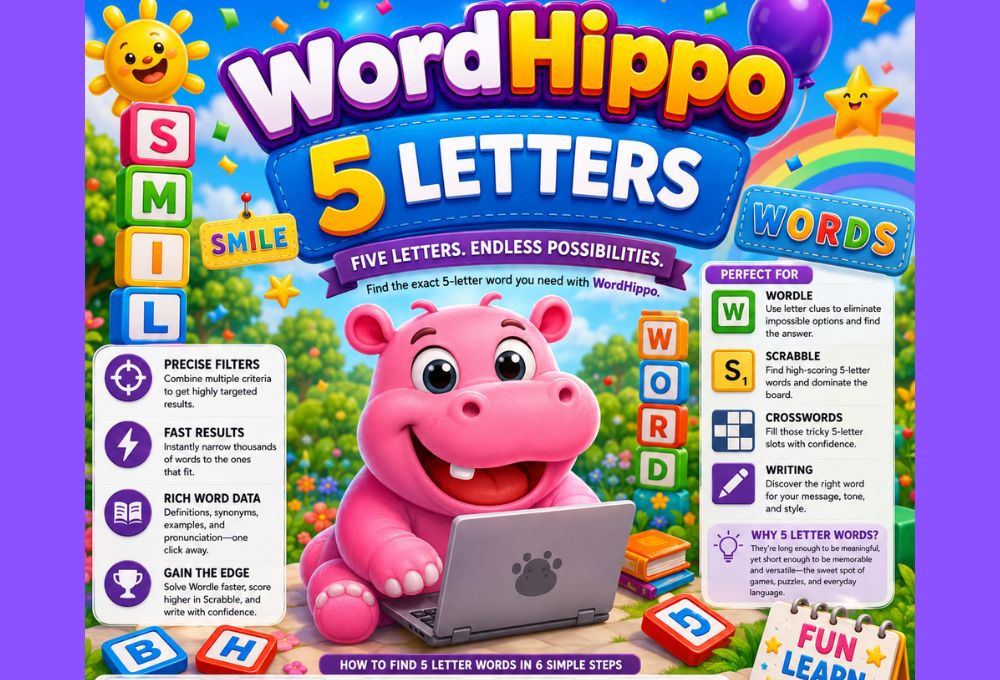
Five letters. That’s all that stands between you and a perfect Wordle score, a crushing Scrabble play, or the exact word that makes a sentence sing. The problem is that the English language contains thousands of five-letter combinations — far too many to sift through by memory alone. That’s where WordHippo comes in.
WordHippo’s 5-letter word finder is one of the most powerful and underused tools in any word game player’s or writer’s arsenal. This guide breaks down exactly what it does, how to use every feature, and how to get results that go well beyond what most people extract from the platform.
What Is WordHippo, and Why Does It Matter for 5 Letter Words?
WordHippo (wordhippo.com) launched in 2008 as a comprehensive online language platform. Over the years, it has grown into far more than a dictionary or thesaurus. Today it functions as a dynamic word finder, synonym engine, translator, rhyming tool, and pronunciation guide — all under one roof.
The feature that draws the most search traffic, particularly since the viral rise of Wordle in 2022, is its word finder and unscrambler tool. Within that tool, the five-letter word filter is the most heavily used configuration by a significant margin.
What makes WordHippo different from simply Googling “5-letter words starting with S”? The answer is precision. WordHippo lets you layer multiple filters at once — starting letter, ending letter, letters contained in any position, letters to exclude, and word type (noun, verb, adjective, adverb) — all while locking the result length to exactly five characters. That level of control turns an otherwise overwhelming word list into a targeted, manageable set of candidates.
Why Five-Letter Words Specifically?
Before diving into the tool itself, it’s worth understanding why five-letter words occupy such a distinct and useful space in English.
Five-letter words hit a linguistic sweet spot. They are long enough to carry real meaning and nuance — unlike two- or three-letter words, which tend toward grammatical function — yet short enough to be memorable and easy to work with in constrained formats. This is why games, puzzles, and educational exercises lean so heavily on them.
In Wordle, every answer is exactly five letters. The entire logic of the game — green tiles, yellow tiles, gray eliminations — is built around narrowing down a pool of five-letter possibilities. Players who internalize the common five-letter patterns solve the puzzle faster and with fewer wasted guesses.
In Scrabble and Words with Friends, five-letter words often balance point value with board flexibility. Unlike seven-letter bingos that require a perfect rack, five-letter plays are achievable more often, and high-scoring five-letter words with Q, X, Z, or J can shift the outcome of a game.
In crosswords, five-letter entries are among the most common fill lengths. Constructors rely on them heavily because they fit comfortably into both across and down slots, and solvers often find themselves stuck on exactly these entries.
For writers, five-letter words are the workhorses of clear prose. They’re specific without being cumbersome, and when you need a synonym that fits a particular rhythm or register, searching by length and meaning simultaneously — something WordHippo enables — saves real time.
A Full Tour of the WordHippo 5 Word Finder
The WordHippo word finder lives at wordhippo.com/what-is/word-finder-unscrambler.html. Here is what you’ll actually find when you open it.
The Basic Search Bar
The homepage search bar includes a dropdown for word length — everything from 2 letters to 14. Select “5 letters” and begin typing known letters, and the tool returns matches immediately. This is the fastest path to a broad list of five-letter words.
The Advanced Word Finder
For most serious use cases, the Advanced Word Search is where you want to be. It offers the following independent filter fields:
- Starts with — Enter the first letter or first two letters of the word.
- In the middle — Specify letters that appear in the interior positions.
- Ends with — Enter the final letter or letters.
- Anywhere — Enter a letter or sequence that must appear somewhere in the word, with no position constraint.
- Exclude — Enter letters that the word must not contain.
- Word length — Set this to 5.
- Word type — Filter by noun, verb, adjective, or adverb.
- Common words only — A toggle that hides rare or archaic entries when you want practical, everyday results.
These fields work in combination. That is the tool’s real power. You’re not choosing one filter — you’re stacking them to zero in on a precise target.
How to Use WordHippo 5 Letter Words: Step-by-Step
Here is the complete step-by-step guide to using Wordhippo 5 letter words.
Step 1 — Go to the Word Finder
Navigate to wordhippo.com and click “Find Words” in the main navigation, then select “Advanced Word Finder.” You can also reach it directly at the URL above.
Step 2 — Set Word Length to 5
This is the foundational filter. Everything else is layered on top of it. The dropdown is labeled “Word length” — select “5 letters” before doing anything else.
Step 3 — Enter What You Already Know
This is where the tool diverges from a simple word list. Think about what information you already have:
- Know the first letter? Enter it in “Starts with.”
- Know the last letter? Enter it in “Ends with.”
- Know a letter that’s in the word but not sure where? Enter it in “Anywhere.”
- Know letters that definitely aren’t in the word? Enter them in “Exclude.”
For a Wordle-style scenario: imagine you’ve guessed “CRANE” and learned that A is in the word (but not in position 3), and C, R, N, E are definitely not present. You’d enter A in “Anywhere,” then add C, R, N, E in “Exclude.” The results shrink from thousands of candidates to a much smaller, actionable list.
Step 4 — Filter by Word Type (Optional)
If you’re writing rather than playing a game, filtering by noun, verb, or adjective can be enormously helpful. Searching for a five-letter adjective starting with “B” for a headline, for instance, is a task WordHippo handles cleanly.
Step 5 — Toggle Common Words Only
If your results include a lot of archaic or obscure entries you’ve never seen, switch on “Common Words Only.” For Wordle specifically, this is useful because the game draws from everyday vocabulary rather than specialist dictionaries.
Step 6 — Review and Use the Results
WordHippo displays matching words as a list. Clicking any word opens its full entry — definition, synonyms, antonyms, example sentences, and pronunciation. This makes it useful not just for finding a word, but for confirming it means what you think it means before committing.
Also Read: PG Soft Juara100.org Medal Explained: What Is PG Soft and How Its Reward System Works?
WordHippo 5 Letter Words Starting with A
One of the most common specific searches is WordHippo 5 letter words starting with A — a search that’s particularly popular among Wordle players who use A-initial words as opening guesses because A is one of the most frequently occurring vowels in English five-letter words.
Using the tool with “A” in the “Starts with” field and length set to 5 returns a large set of options. Some of the most strategically useful include:
Common vowel-rich starters:
- ADIEU — contains four vowels (A, E, I, U), making it excellent for Wordle opening guesses to rule out multiple vowels at once
- AUDIO — similarly vowel-dense, with A, U, D, I, O
- AROSE — covers A, R, O, S, E — five of the most common letters in English five-letter words
- ALERT — strong consonant-vowel balance, commonly recommended as a Wordle opener
- AFOOT, ALOFT, ALOUD — useful for testing common letter groupings
High-value Scrabble words starting with A:
- AZYMS — uses Z for strong point value
- AXELS — leverages X
- AQUAS — Q without a U, useful for tight board situations
The “starts with A” filter can be further refined. If you know the word starts with A and ends with E, entering both filters simultaneously gives you a much tighter list — words like AMINE, ABODE, AGATE, AGAVE, AFIRE, and ADORE.
Wordle Strategy Using WordHippo
WordHippo is particularly effective as a Wordle aid, and it’s worth walking through a concrete strategy rather than vague advice.
The Opening Guess
Many experienced Wordle players have a fixed opening word they use every day. Good opening words maximize the number of common letters tested in a single guess. Words like CRANE, SLATE, STARE, RAISE, and AROSE are popular for this reason — they test S, T, A, R, E, L, I, N, and O, which together account for a very high proportion of letters appearing in Wordle answers.
WordHippo can help you find and evaluate opening words by searching for five-letter words containing specific combinations of common letters.
Working with Green and Yellow Clues
After your first guess, you know which letters are confirmed (green), which are in the word but in the wrong position (yellow), and which are absent (gray).
In the WordHippo advanced finder:
- Green letters go in “Starts with,” “In the middle,” or “Ends with,” depending on their confirmed position.
- Yellow letters go in “Anywhere.”
- Gray letters go in “Exclude.”
This transforms Wordle from a vocabulary guessing game into a structured elimination exercise. With just two rounds of clues fed into WordHippo, most Wordle puzzles narrow to a handful of candidates — sometimes just one.
The Endgame
One scenario where players struggle is when multiple possible words share the same letters in the same positions, differing only in one slot. For example, if the confirmed pattern is _ ATCH, the answer could be BATCH, CATCH, HATCH, LATCH, MATCH, PATCH, or WATCH. Using the “Exclude” filter with letters you’ve already ruled out dramatically cuts this list. If your prior guesses eliminated B, C, H, and L, you’re left with MATCH, PATCH, and WATCH — a manageable three rather than seven.
Using WordHippo for Scrabble and Words with Friends
Scrabble and Words with Friends reward players who know high-value short words, particularly those containing Q, X, Z, and J. WordHippo’s word finder is effective for building this knowledge.
Searching by contained letters:
Enter Q in “Anywhere” with length set to 5, and you get five-letter words containing Q. Many of these are rare, so toggle off “Common Words Only” to see the full set — important for Scrabble, where uncommon words are perfectly valid.
High-scoring five-letter words worth knowing:
| Word | Notable Letters | Notes |
|---|---|---|
| JAZZY | J, Z, Z | High point value, strong in Words with Friends |
| SQUAB | Q, without needing U after Q | Valid in both Scrabble and WWF |
| PIXEL | X | Common enough to remember, scores well |
| FIZZY | F, Z, Z | Excellent for clearing difficult rack letters |
| QUAFF | Q, F, F | Uses Q without the typical U dependency |
| ZESTY | Z | Common word, solid points, easy to place |
| BOXER | X | Versatile for board positioning |
WordHippo lets you search for each of these systematically. More usefully, it helps you find options when you have a specific awkward rack — say, Q, J, and X simultaneously. Enter your available letters in combination with the five-letter filter and let the tool find what’s actually playable.
WordHippo 5 Letter Words for Crosswords and Codewords
Crossword solving requires a slightly different approach because letter positions are typically fixed by crossing entries. WordHippo’s positional filters handle this well.
If you know the first, third, and fifth letters of a five-letter down entry — say, S in position 1, A in position 3, and E in position 5 — enter S in “Starts with,” A in “In the middle,” and E in “Ends with.” The results give you every valid five-letter word fitting that exact frame: STAKE, STALE, SPARE, SHAKE, SHARE, SHAME, and others, depending on your middle filters.
For codewords — where every square maps to a number and you decode letter by letter — the same approach works. Feed your confirmed positions into the appropriate filter fields and let the tool narrow the field.
WordHippo also has a dedicated Crossword/Codeword solver at a separate URL, but the advanced word finder is often more flexible for partial-information situations.
WordHippo for Vocabulary Learning and Writing
The gaming applications are obvious, but WordHippo’s value for writers and language learners is just as real.
Building themed word lists: Teachers and students can use the five-letter filter combined with the word type filter to generate focused vocabulary sets. Five-letter nouns related to nature, five-letter verbs for action writing, five-letter adjectives for descriptive exercises — each is a specific, achievable search.
Finding the right rhythm in prose: Writers working on poetry, song lyrics, or any rhythmically sensitive text sometimes need a word of a specific length. Needing a two-syllable five-letter adjective meaning “calm”? WordHippo’s combination of the word finder and thesaurus features handles this kind of query.
Exploring synonyms by length: Start from a word you know, use WordHippo’s synonym feature, and then note which synonyms happen to be five letters. This is a practical shortcut for writers who need variety without disrupting sentence flow.
Spelling practice: Five-letter words are a productive unit for spelling study. They’re complex enough to include common problem patterns — double letters, silent letters, unusual vowel combinations — without being so long that they become discouraging. Using WordHippo to generate five-letter word lists by pattern (words containing “ough,” words ending in “tion” truncated, words with double consonants) makes spelling study more structured.
Explore Also: Steal a Brainrot Unblocked: How to Play, Tips, and Everything You Need to Know
Tips for Getting More from WordHippo 5 Letter Word Searches
1. Use the exclude field aggressively. Most people use “Starts with” and “Ends with” but neglect “Exclude.” In Wordle, the exclude field is arguably the most powerful filter because it removes entire swaths of the vocabulary based on what you know isn’t there.
2. Try combinations you wouldn’t think to hand-search. “Five-letter words starting with QU, ending in K” is not something you’d easily enumerate mentally. WordHippo handles it in seconds.
3. Toggle Common Words on and off strategically. Keep it on for Wordle (the game uses common vocabulary) and off for Scrabble (where obscure words can be advantageous).
4. Click through to the full word entry. Don’t just grab a word from the list and use it. Click it to confirm the definition. In Wordle, a word that feels familiar might mean something you didn’t expect. In Scrabble, knowing a word’s part of speech matters for challenged plays.
5. Use WordHippo alongside, not instead of, game strategy. The tool is most effective when you already understand the logic of the game you’re playing. A Wordle player who understands letter frequency, position probability, and elimination strategy will use WordHippo far more effectively than someone just browsing random results.
6. Bookmark the Advanced Word Finder directly. The homepage search defaults to a general query. Going straight to the advanced finder saves clicks and gets you to the five-letter filter faster.
Common Mistakes When Using WordHippo for 5 Letter Words
Entering too many constraints too early. If you specify a starting letter, a middle letter, and an ending letter from the beginning and get zero results, the problem may be that your constraints are mutually exclusive — there may not be a common English word satisfying all three. Start with fewer filters and add more as needed.
Ignoring the word type filter. For writing tasks, forgetting to filter by word type leads to lists that include nouns when you need adjectives, or vice versa. A few extra seconds on the filter setup saves significant scrolling time.
Treating every result as a valid Wordle guess. WordHippo’s database is larger than Wordle’s answer pool. Some valid English words will be rejected by Wordle as not in its dictionary. If a word feels obscure, it may not be accepted. Use the “Common Words Only” toggle to reduce this risk.
Not exploring the word after finding it. WordHippo’s real depth is in the full word entry — synonyms, antonyms, example sentences, and pronunciation audio. Players and writers who stop at the list miss the most educational part of the tool.
WordHippo vs. Other 5 Letter Word Tools
WordHippo is not the only word finder available, and it’s worth knowing how it compares.
Word.tips and Merriam-Webster’s Word Finder offer similar filter capabilities, but often with smaller databases. WordHippo’s database depth — particularly for uncommon words — is a consistent advantage for Scrabble players.
Wordle-specific tools (like Wordle Solver apps) are more narrowly optimized for Wordle’s specific answer pool and can be faster for that single use case. However, they’re useless for Scrabble, writing, or vocabulary learning. WordHippo’s flexibility across use cases makes it a better default tool.
Quordle and Octordle solvers exist for multi-board Wordle variants but require more specialized tools. WordHippo’s basic filters still apply; you just need to run multiple simultaneous filter sets in your head while the tool handles each board separately.
The clearest differentiator for WordHippo remains its combination of scope and integration: the word finder, thesaurus, dictionary, and translator all coexist on one platform, which means you don’t need to switch tabs to confirm a word’s meaning or find a synonym of the right length.
Conclusion
WordHippo’s five-letter word finder is one of those tools that appears simple on the surface but rewards deeper use significantly. The basic search takes seconds. The advanced finder, with layered filters for position, inclusion, exclusion, and word type, is capable of narrowing thousands of candidates to a precise handful in moments.
Whether you’re three guesses into a Wordle puzzle with two yellow tiles and four gray letters, building a Scrabble rack around a high-value Q, constructing a crossword entry from partial crossing letters, or simply looking for the right five-letter word to tighten a sentence — WordHippo is the fastest and most flexible tool available for the job.
The key is learning to use the filters in combination rather than in isolation. Start with “Ends with” or “Starts with,” add “Anywhere” for confirmed letters without confirmed positions, and let “Exclude” do the heavy elimination work. Within two or three filter adjustments, you’ll have a list you can actually work with.
Five letters. Used well, with the right tool, they’re enough for almost anything.
Frequently Asked Questions
Does WordHippo work on mobile?
Yes. The site is mobile-responsive and functions on both iOS and Android browsers. WordHippo also offers dedicated iOS and Android apps for users who prefer a native experience.
Is WordHippo free to use for 5-letter word searches?
Yes. The word finder and all filtering features are completely free. No account registration is required. WordHippo is supported by advertising rather than subscriptions.
Can I search for WordHippo 5-letter words starting with a specific two-letter combination?
Yes. The “Starts with” field accepts multiple letters, so entering “ST” and setting the length to 5 returns all five-letter words beginning with ST — STARE, STOVE, STONE, STALL, STAKE, and many more.
Does WordHippo cover all valid Scrabble words?
WordHippo’s database covers standard English dictionaries and includes most words valid in tournament Scrabble play. However, for competitive Scrabble, confirming words against the Official Scrabble Players Dictionary (OSPD) or TWL/SOWPODS is advisable, as dictionary editions differ in edge cases.
Can WordHippo help with five-letter words in languages other than English?
WordHippo supports a range of languages for translation and some dictionary features, but the advanced word finder is primarily optimized for English. For dedicated non-English word game solving, language-specific tools are more reliable.
How many five-letter words does WordHippo have in its database?
WordHippo’s database spans thousands of five-letter English words across common and uncommon vocabulary. The exact count varies by source, but the pool is large enough that searches involving two or three combined filters will almost always yield multiple valid results.
Is it “cheating” to use WordHippo for Wordle?
This depends on how you play. Many people use WordHippo purely as a learning tool — reviewing their guesses after the fact to understand what words they missed. Others use it during play when stuck. There’s no official rule against it; Wordle is a personal daily puzzle rather than a competitive game in the traditional sense. For most players, the real goal is vocabulary growth and daily mental engagement, and WordHippo serves both whether used during or after play.