Search “content cluster case study,” and you’ll find the same story, wearing different logos. A company with a twelve-person marketing team restructures three hundred pages. They add three hundred and forty internal links. Domain Rating climbs from 52 to something respectable, traffic jumps 40%, and somewhere in the write-up, there’s a diagram with a hub in the middle and eight spokes radiating out like a wheel.
None of that tells you what it’s actually like to build a cluster when it’s just you.
I recently put together a three-article cluster around Framework’s 13-inch laptop lineup — a review, a buying guide, and a comparison piece. No marketing team, no content audit spreadsheet, no quarterly cluster review meeting. Just three articles that needed to exist, in the right order, linked to each other in a way that didn’t feel like I was repeating myself three times over. Here’s what that actually involved.
What does a cluster look like at this scale?
Three pieces, each one able to stand completely on its own.
The Framework Laptop 13 Pro Review covers one specific model in depth — what it’s like to actually use, where it earns its premium positioning, where it doesn’t. The Framework Laptop Buying Guide zooms out to the full lineup, because Framework isn’t one laptop anymore — it’s five different products, and picking the wrong one is an easy mistake to make. And Framework vs. Sealed-Chassis Laptops zooms out further still, past Framework entirely, into the actual decision someone’s making when they consider a repairable laptop at all.
Three felt right for this topic. Not five, not ten. Any more and I’d have been inventing subtopics just to hit a number, which is its own kind of padding — the same sin as writing 3,000 words to cover a subject that only needed 800.
Which article do you write first?
I wrote the review first, then the buying guide, then the comparison. That order wasn’t arbitrary.
You can’t write a genuinely useful buying guide until you’ve actually spent time with at least one model and know what the tradeoffs feel like in practice, not just on a spec sheet. Writing the 13 Pro review first gave me that grounding. Once it existed, the buying guide could reference something concrete — if you want what the Pro delivers, here’s when the base model is enough instead — rather than comparing five products in the abstract.
The comparison piece came last because it needed both of the others to already exist. It’s the widest-angle piece in the cluster, and it only works if there’s already depth underneath it to point back to. Write it first, before the review and guide exist, and you end up making promises the rest of the cluster hasn’t earned yet.
If you’re planning your own small cluster, this is worth sitting with before you write anything: start with whichever piece requires the most direct, specific knowledge, and let the broader pieces build outward from it. Working the other way — starting broad and narrowing down — tends to produce a top piece that reads like an outline nobody filled in.
How do you link three pages without repeating yourself?
This is the part the big case studies genuinely can’t help you with, because their math is different from yours.
When an agency is placing 340 links across 400 pages, anchor text variation is easy — there’s enough surface area that no single link carries much weight, and no reader is going to notice if “content cluster” shows up as anchor text a dozen times spread across a huge site. When you have three pages, every single internal link is doing real work, and a reader moving through all three pieces in one sitting will absolutely notice if you use “check out our buying guide” three times in three different articles.
What worked for me: each piece links to both of the others, but never with the same anchor text or the same framing twice. In the review, the mention of the buying guide comes attached to a specific claim — if you’re trying to figure out which of the five current models is worth the money, that’s a separate question — rather than a generic pointer. In the buying guide, the review gets linked from a sentence about what long-term use actually looks like, not from a “read more” tag stapled to the bottom.
Placement mattered as much as anchor text. I put the first link to another piece in the cluster within the first third of the article — not buried in a related-reading block at the very end, where readers who already found what they needed have no reason to click. A related-reading block at the bottom is fine as a backup, but it shouldn’t be doing the only work.
What does the tooling actually look like across three pieces?
Nobody’s marketing team is checking your work here, so the tools have to do some of that job.
I ran each piece through RankMath before publishing, but not as a pass/fail gate — more as a hygiene checklist. It’ll flag the obvious stuff: missing alt text, a meta description running long, a keyword that isn’t showing up in a subheading. None of that tells you whether the piece is actually good, and a green score on all three articles doesn’t mean the cluster holds together. It just means none of the three pieces has an easy, avoidable flaw sitting in it.
The other pass I run on everything now is a humanization check — reading back through for anything that sounds like it was written to hit a structure rather than to answer a question. With three articles on the same narrow topic, written close together, this pass matters more than usual. It’s easy for phrasing to start echoing itself piece by piece, and an AI-detection score creeping up on the third article is often just a symptom of that — the same sentence rhythm reused because it worked the first time. Reading all three back to back, out loud if needed, catches that faster than any tool does. Contractions, a dropped-in aside, a rhetorical question where a flat statement would’ve sounded scripted — small things, but they’re what stop three linked articles from reading like one article copy-pasted with the nouns swapped.
What’s the hardest part nobody warns you about?
Deciding which piece is “the pillar.”
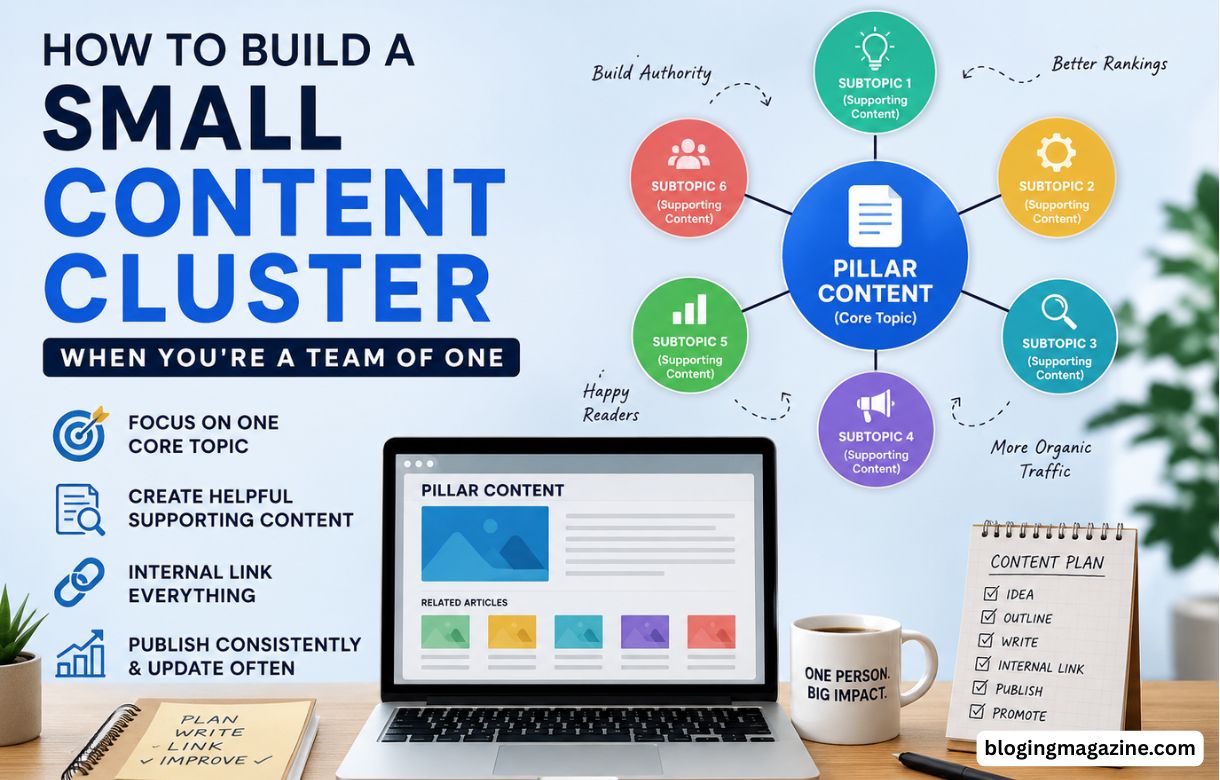
Every guide on pillar pages assumes there’s an obvious hub — one broad piece, several narrower ones feeding into it. My three pieces didn’t sort themselves that cleanly. The buying guide is the broadest in scope, which makes it the closest thing to a pillar. But the comparison piece stands on its own just as well, and plenty of readers will land there first, from a completely different search intent, and never touch the buying guide at all.
I stopped trying to force a strict hub-and-spoke shape onto it. Instead, I treated all three as peers that reference each other, rather than one parent with two children. That’s a real departure from how the pillar-page model is usually described, and it’s the kind of decision a solo writer has to make on instinct, because there’s no framework written for a cluster this small.
The other quiet difficulty: keeping three pieces from feeling like the same article wearing different headings. With one person writing all three, in the same week, on the same topic, the risk of overlap is real. I caught myself reusing the same framing sentence in two drafts and had to go back and genuinely differentiate the angle, not just the word count.
Is a cluster even worth it at this size?
For this topic, yes — three distinct reader intents (how good is this one model, which model should I buy, should I even consider this category of laptop) genuinely needed three different articles. But I wouldn’t force every topic into a cluster just because clusters are the recommended shape. If a topic only has one real question behind it, a single comprehensive piece will always beat three thin ones stretched to look like a system.
The honest test: could you delete one of the three articles and have the other two visibly lose something? If yes, the cluster is earning its size. If not, you’ve probably built three drafts of one article and called it a strategy.
FAQ
How many articles should a content cluster have?
There’s no fixed number. What matters is whether each piece answers a genuinely distinct question. Three tightly differentiated articles will outperform ten that overlap.
Do you need a dedicated pillar page for a small cluster?
Not necessarily. With only a few pieces, it can work better to treat them as equal, cross-linked peers rather than forcing a strict hub-and-spoke structure that doesn’t fit the topic.
How long does it take to build a three-article cluster as a solo writer?
It depends on research depth, but expect the sequencing — writing the most specific piece first, then building outward — to add real time compared to writing three unrelated articles. The linking pass alone, done carefully, isn’t something to rush.