Every new blogger eventually asks the same question: should I focus on affiliate links or just slap some ads on the site and wait for traffic to build? Most articles answer this with vague pros-and-cons lists — ads are passive, affiliates need more work, both are “worth trying.” None of them actually run the numbers at the traffic level where most bloggers are standing right now.
So let’s run them.
The short answer
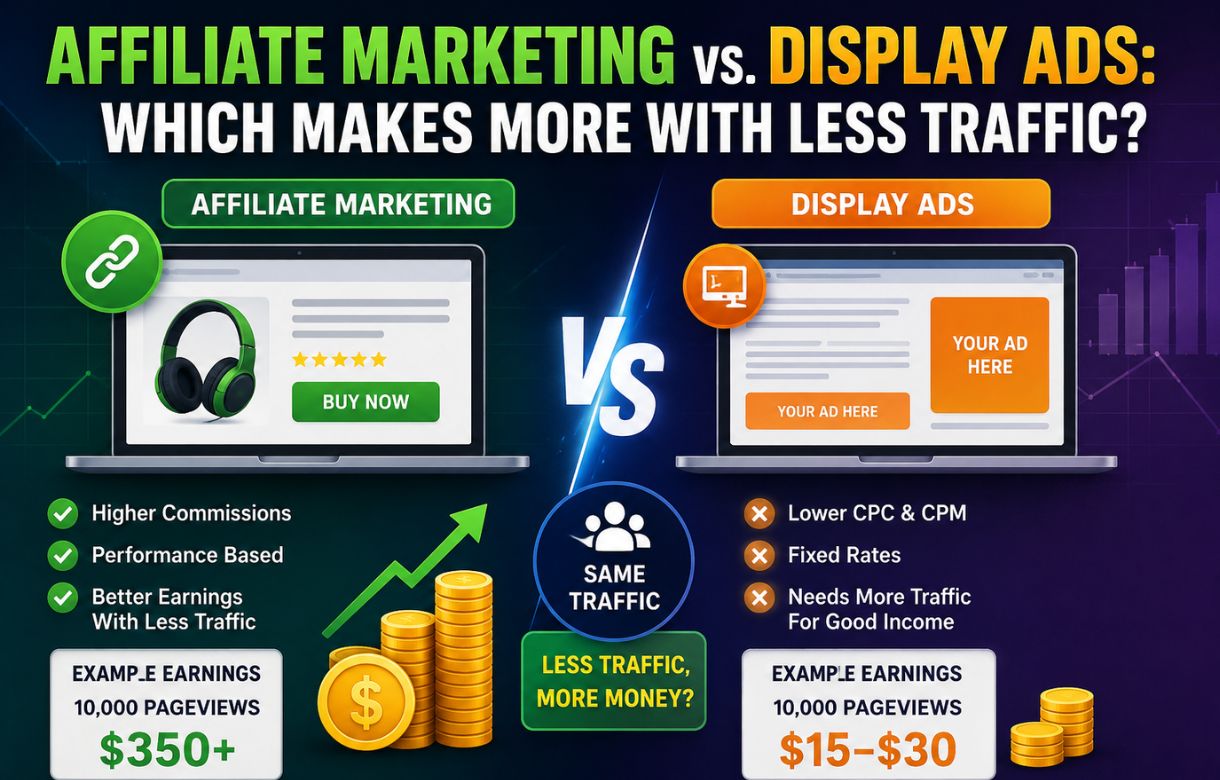
At low traffic — anywhere under about 20,000 monthly pageviews — affiliate marketing almost always earns more per visitor than display ads. Ads pay you for attention. Affiliates pay you for action. When you don’t have much attention to sell yet, action is the better trade.
But that answer comes with real caveats, and the traffic level at which this flips is worth understanding before you pick a lane.
What each model actually pays you
Display ads pay based on impressions, usually expressed as RPM (revenue per thousand pageviews). For a new blog on a beginner network like AdSense, that’s often somewhere between $2 and $15 per thousand pageviews, depending on niche and audience location. Higher-paying networks like Mediavine or AdThrive pay more, sometimes $15 to $30+ RPM, but they also require a minimum traffic threshold before they’ll even let you join — usually 50,000 monthly sessions or more. Until you hit that, you’re stuck with the lower-paying networks almost by default.
Affiliate marketing pays per action instead of per view. A single sale might earn you anywhere from a few dollars to over $100, depending on the product and commission rate. The catch is that most visitors won’t buy anything — conversion rates on well-targeted affiliate content typically land somewhere between 1% and 5%. But because the payout per conversion is so much higher than a fractional-cent ad impression, you need far fewer total visitors to hit the same revenue number.
Running the numbers at three traffic levels
Here’s what this actually looks like when you plug in real traffic tiers. These are estimates, not guarantees — actual results swing hard based on niche, content quality, and audience intent — but the pattern holds consistently across most blogging niches.
| Monthly pageviews | Display ads (est. revenue) | Affiliate marketing (est. revenue) |
|---|---|---|
| 1,000 | $2 – $10 | $20 – $100+ |
| 5,000 | $10 – $50 | $100 – $500 |
| 20,000 | $40 – $200 | $300 – $1,000+ |
| 100,000 | $200 – $1,500 | Highly variable — depends on offer mix |
The ad estimates assume beginner-network RPMs, since most blogs at these traffic levels haven’t hit the threshold for premium networks yet. The affiliate estimates assume the content is built around buyer-intent keywords — comparison posts, “best X for Y” roundups, reviews — not general informational content, since that’s what actually converts.
Notice what happens at the low end. At 1,000 monthly pageviews, ads are basically not worth setting up — you’d be earning pocket change for the effort of installing and maintaining an ad network. A single well-placed affiliate link in a well-targeted post can outearn the entire ad revenue from ten times fewer visitors.
By the time you’re at 100,000 pageviews, the picture gets murkier. Ads become a genuinely reliable income at that scale, and if you qualify for a premium network, the gap narrows fast. Affiliate income at high traffic depends entirely on whether your content stayed buyer-intent focused as you scaled, or whether growth came from broad informational posts that don’t convert as well.
At what traffic level do display ads start to outperform affiliate marketing?
There’s no fixed crossover point, but it typically starts to shift somewhere around 50,000 to 100,000 monthly pageviews — the range where premium ad networks become accessible, and RPMs jump meaningfully. Below that range, affiliate marketing usually wins on a per-visitor basis, assuming the content is genuinely built around products and buying decisions rather than general information.
Why the comparison isn’t actually fair
Here’s the part most comparison articles skip: these two models don’t compete for the same traffic. Ads monetize every single visitor, no matter why they showed up. Someone reading “why is my sourdough starter not rising” isn’t going to click an affiliate link for a stand mixer, but they’ll still generate an ad impression. Affiliate marketing, on the other hand, only pays off on traffic that arrives with a decision in mind — which is a smaller slice of most blogs’ total readership.
That means the real question isn’t “which model makes more money” in the abstract. It’s “how much of my traffic is actually buyer-intent traffic, and am I monetizing that slice correctly?” A blog that’s 90% informational content will lean toward ads by necessity, because there’s nothing else to sell to most of that traffic. A blog built deliberately around comparison and review content can lean hard into affiliates, because nearly all its traffic already has a decision on the table.
The case for running both
Nearly every blogger who’s actually built revenue at scale ends up running both models side by side, and the logic is straightforward once you see it laid out. Ads capture the value of traffic that would otherwise earn nothing — the informational posts, the how-tos, the general-interest content that ranks well but doesn’t naturally lead to a purchase. Affiliate links capture the far higher value sitting in your buyer-intent posts, the ones where someone showed up already comparing options.
Running only ads on a small blog leaves real money on the table, since a handful of well-placed affiliate links in your best-converting posts could outearn your entire ad revenue. Running only affiliates on a broad, informational blog leaves the rest of your traffic completely unmonetized, since ads would have paid you something for visitors who were never going to buy anything anyway.
Should a new blog start with affiliate marketing or display ads?
For a new blog under 20,000 monthly pageviews, start with affiliate marketing on any buyer-intent content, and add display ads as a baseline layer once your traffic clears the minimum threshold most networks require. Waiting until you hit six figures of traffic to introduce affiliate links means leaving your highest-value visitors unmonetized for months, purely because the “add ads first” order feels simpler.
The real takeaway
Traffic size shouldn’t decide which model you use — content type should. If a post exists to help someone make a buying decision, put the effort into affiliate placements, because at low traffic, that’s where the real money sits. If a post exists to answer a general question with no natural product tie-in, let it earn its keep through ads instead. Most blogs eventually need both, but the mistake is treating this as an either-or decision when it’s really a matter of matching the right monetization method to the right piece of content.
Frequently Asked Questions
What are the downsides of relying on display ads?
The biggest one is that revenue is tied directly to traffic volume, so a slow month for pageviews is automatically a slow month for income, with no way to make up the gap through better content alone. Ads also tend to pay very little per visitor until a blog reaches six-figure monthly traffic, and too many ad placements on a page can hurt user experience and even work against Google’s page experience signals.
Is affiliate marketing a form of advertising?
Not exactly. Traditional advertising pays for exposure — impressions, clicks, airtime — regardless of whether anyone buys anything. Affiliate marketing only pays out when a specific action happens, usually a sale or signup. It’s better thought of as a commission-based partnership than a form of advertising, even though it often lives inside content that looks like an ad.
Do display ads generally perform better than search ads?
They serve different purposes, so “better” depends on the goal. Search ads (like Google Ads) target people actively searching for something, which usually means higher intent and better conversion rates, but at a real cost per click. Display ads on a blog cost the visitor nothing and monetize passively, but they convert far less directly since the visitor wasn’t necessarily looking to buy anything. For a blogger monetizing their own content, display ads and search ads aren’t really comparable — one is a way to earn from your site; the other is a way to pay for traffic to it.
Which pays off better overall, affiliate marketing or a broader digital marketing approach?
This compares two different things, since affiliate marketing is one specific monetization tactic, while digital marketing is the umbrella that includes SEO, email, social, and paid ads working together. In practice, affiliate marketing tends to perform best when it’s supported by a broader digital marketing strategy rather than standing alone — an email list or a strong SEO presence will consistently outearn affiliate links dropped into a site with no other traffic strategy behind them.
Is it a good idea to run display ads on a site that’s mainly built for affiliate content?
Usually, yes, as long as it’s done carefully. Ads capture value from the portion of your traffic that isn’t going to click an affiliate link anyway — readers researching but not ready to buy, or landing on a post that doesn’t have a natural product fit. The risk is overdoing it: too many ads on a review or comparison page can visually compete with your affiliate links and actually drag down conversions, so it’s worth keeping ad placement lighter on your highest-converting affiliate posts