Financial crime doesn’t move at the speed it used to. It moves at the speed of instant payments — milliseconds, not days. That single shift is why “AML compliance software” has quietly become one of the most searched terms among banks, fintechs, and payment providers over the past two years.
But the term gets thrown around loosely. Some people mean a KYC onboarding tool. Others mean a full transaction monitoring engine. A few just mean “whatever keeps the regulator happy.” This guide sorts that out, plainly, without the vendor-brochure language.
What Does AML Compliance Software Actually Do?
At its core, AML (anti-money laundering) compliance software helps financial institutions spot, flag, and report suspicious financial activity before it turns into a regulatory problem — or a headline.
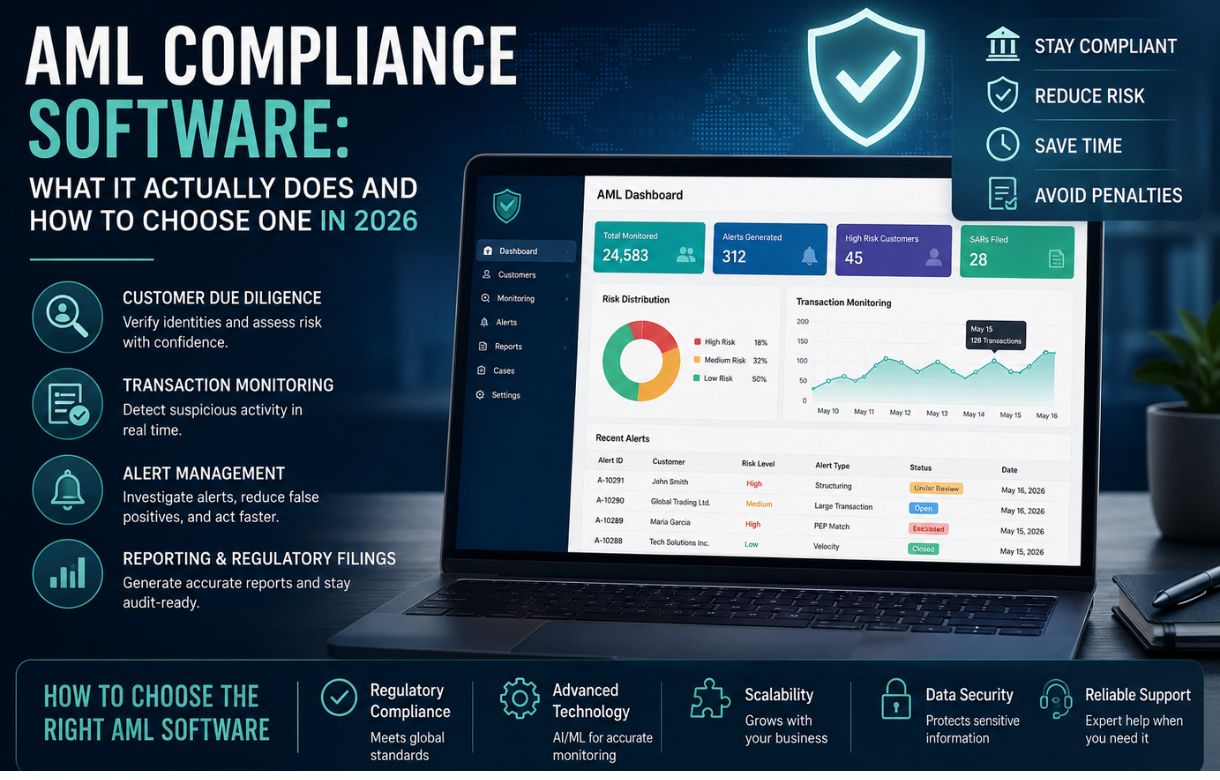
That usually breaks down into a few connected jobs: screening customers during onboarding, watching transactions as they happen, flagging patterns that look like layering or structuring, and generating the paperwork regulators expect when something looks wrong.
None of this is optional. It’s not a “nice to have” layered on top of banking operations — it’s the plumbing that keeps a financial institution licensed to operate.
Why Are Legacy AML Systems Failing Banks Right Now?
Most of the AML software still running inside mid-size and regional banks was built for a slower era of banking, when a suspicious transfer might take a day or two to clear.
That’s no longer how money moves. Instant payment rails have collapsed the window between “funds sent” and “funds gone” to almost nothing. Mule account networks exploit exactly this gap — moving stolen or laundered funds through a chain of accounts before any human reviewer even sees the first alert.
Rule-based systems respond to this by casting a wider net. More rules, more thresholds, more alerts. The problem is that most of those alerts turn out to be nothing. Compliance teams end up buried under false positives, and the one genuinely suspicious transaction gets lost in the noise. That’s not a hypothetical — it’s the single most common complaint among AML analysts, and it’s the reason “alert fatigue” shows up in nearly every industry survey on financial crime operations.
Rule-Based vs AI-Driven AML Software: What’s the Real Difference?
This is where a lot of buying decisions go wrong, so it’s worth being precise about it.
Rule-based systems work off fixed logic: if a transaction crosses $X, or moves through Y countries, flag it. They’re predictable and easy to audit, but they can’t adapt to new fraud typologies without a manual rule update — which can take weeks to push through change-management processes.
AI-driven systems, by contrast, learn from transaction patterns and can surface anomalies that don’t match any predefined rule. In theory, that means catching novel fraud faster. In practice, it depends heavily on the quality of training data and how explainable the model’s decisions are — a black-box AI flag is nearly useless to a compliance officer who has to justify that flag to a regulator.
The honest answer is that most serious AML platforms today aren’t purely one or the other. They pair rule-based logic for known typologies with machine learning for pattern detection, and increasingly with explainable AI so investigators can actually see why a transaction was flagged rather than just being told to trust the model.
What Features Should You Actually Look For?
Buying AML software by a feature checklist is how a lot of institutions end up with tools nobody uses properly. A few things matter more than the rest.
Real-time transaction monitoring matters more than batch processing, especially anywhere instant payment rails are in use — batch monitoring simply can’t keep up with money that moves in seconds.
Explainability matters more than raw detection accuracy. A system that flags fraud correctly 95% of the time but can’t explain why is a liability during a regulatory audit, not an asset.
Case management workflow matters more than most buyers expect going in. Detection is only half the job — investigators still need a clean, auditable way to review, escalate, and close cases without switching between five different tools.
And typology sharing — the ability to benchmark against fraud patterns seen across other institutions, not just your own historical data — is becoming a genuine differentiator, particularly for smaller banks that don’t have enough internal fraud data to train a model well on their own.
How Does AI Actually Improve Mule Account Detection?
Mule accounts are one of the hardest problems in modern AML because, individually, each transaction can look completely ordinary. The red flag only appears when you look at the network — dozens of accounts, opened around the same time, moving similar amounts through a common endpoint.
That’s a pattern-recognition problem, not a threshold problem, which is exactly why rule-based systems struggle with it. AI models trained on network behavior can pick up on these coordinated patterns far earlier than a static rule ever would, sometimes flagging a mule network before the second or third transaction clears rather than the fifteenth.
It’s worth being clear-eyed here too: AI doesn’t eliminate mule fraud. It shortens the detection window. That’s a meaningful improvement, but it’s not the same as solving the problem outright, and any vendor claiming otherwise is overselling.
How Much Does AML Compliance Software Cost?
This is genuinely hard to pin down because pricing varies enormously by institution size, transaction volume, and deployment model.
Enterprise-grade platforms built for large banks typically run into six or seven figures annually once implementation, integration, and ongoing support are factored in. Cloud-native platforms aimed at mid-size banks and fintechs tend to price on transaction volume or active accounts monitored, which can make costs more predictable but also means they scale up quickly as a business grows.
Smaller fintechs and regional players increasingly lean toward SaaS-based AML tools with lower upfront costs, precisely because the enterprise pricing model doesn’t make sense at their volume. If a vendor won’t give you a straight answer on pricing structure before a sales call, that’s usually a sign the number is negotiable — and worth pushing on.
Is AML Software Worth It for Smaller Financial Institutions?
Yes, but the calculus is different than it is for a national bank.
A smaller institution doesn’t need — and generally can’t afford — the same platform a tier-one bank runs. What it needs is a system that’s genuinely proportionate to its risk profile and transaction volume, with cloud deployment that doesn’t require an in-house infrastructure team to maintain.
The risk of skipping proper AML software isn’t just regulatory fines, either, though those are real. It’s reputational. A single high-profile mule account scandal can do more damage to a small fintech’s trust with users and banking partners than the software would have cost in the first place.
What Are the Biggest Mistakes Institutions Make When Choosing AML Software?
The most common one is buying for the audit instead of buying for the actual risk. Plenty of institutions pick whatever system checks the most boxes on a regulator’s questionnaire, without asking whether it fits how their transactions actually flow.
A close second is underestimating implementation time. AML software integration touches core banking systems, and vendors routinely quote optimistic timelines that don’t survive contact with legacy infrastructure. Build in more time than the sales deck suggests.
And the third, less talked about, is ignoring the compliance team’s actual workflow. A platform can have excellent detection and still fail in practice if investigators find the case management interface clunky enough that they start working around it instead of through it.
Frequently Asked Questions
Do all banks legally need AML compliance software?
Any regulated financial institution handling customer funds is generally required to have anti-money laundering controls in place, and at meaningful transaction volume, doing that manually stops being realistic. The specific software isn’t usually mandated by name, but the underlying capability is.
What’s the difference between AML software and KYC software?
KYC (know your customer) tools focus on verifying identity at onboarding — who someone is. AML software focuses on ongoing behavior — what someone does with their account after that. Many platforms now bundle both, but they’re solving different problems.
Can a small fintech realistically use an enterprise-grade AML platform?
Technically yes, but it’s rarely the right fit. Enterprise platforms are usually priced and built around transaction volumes far higher than a small fintech generates, which means paying for capacity that never gets used.
How long does it typically take to implement AML software?
It depends on how deeply the system needs to integrate with existing core banking infrastructure, but implementations commonly stretch from a few months to over a year for larger institutions. Anyone promising a go-live in weeks for a full enterprise deployment is likely underselling the complexity.
Does AI-based AML software reduce false positives?
It can, particularly systems built with explainable AI, but the reduction depends heavily on how well the model is trained on an institution’s specific transaction patterns. It’s not an automatic guarantee out of the box.