Search “does AI content rank on Google” and you’ll get two confident, opposite answers. One camp says AI content is quietly banned, buried, or filtered out before it ever reaches page one. The other says it’s everywhere in the top ten, and nobody can tell the difference anymore. Both are describing the same data and somehow landing in different places.
Here’s the less exciting version: AI content isn’t banned. It’s just held to the same bar as everything else, and most of it doesn’t clear that bar unedited. The two things actually dragging AI drafts down are fabricated facts and thin, unedited writing — not the fact that a model wrote the first pass.
Does AI content actually rank on Google?
Yes, but not evenly. A Semrush analysis of 42,000 blog posts found human-written content held the #1 spot roughly 80% of the time, compared to about 9% for purely AI-generated pages. The gap was widest right at the top and narrowed further down page one.
A separate 16-month study tracking 4,200 articles found something more useful than a scary headline number: pure, unedited AI content ranked about 23% lower on average than human-written pieces targeting the same keywords. But AI-drafted content that got substantive human editing — real fact-checking, original data, expert input — came within 4% of fully human-written content. The same study found unedited AI content picked up 61% fewer editorial backlinks, which matters more than either ranking gap, since backlinks remain one of the strongest signals Google uses.
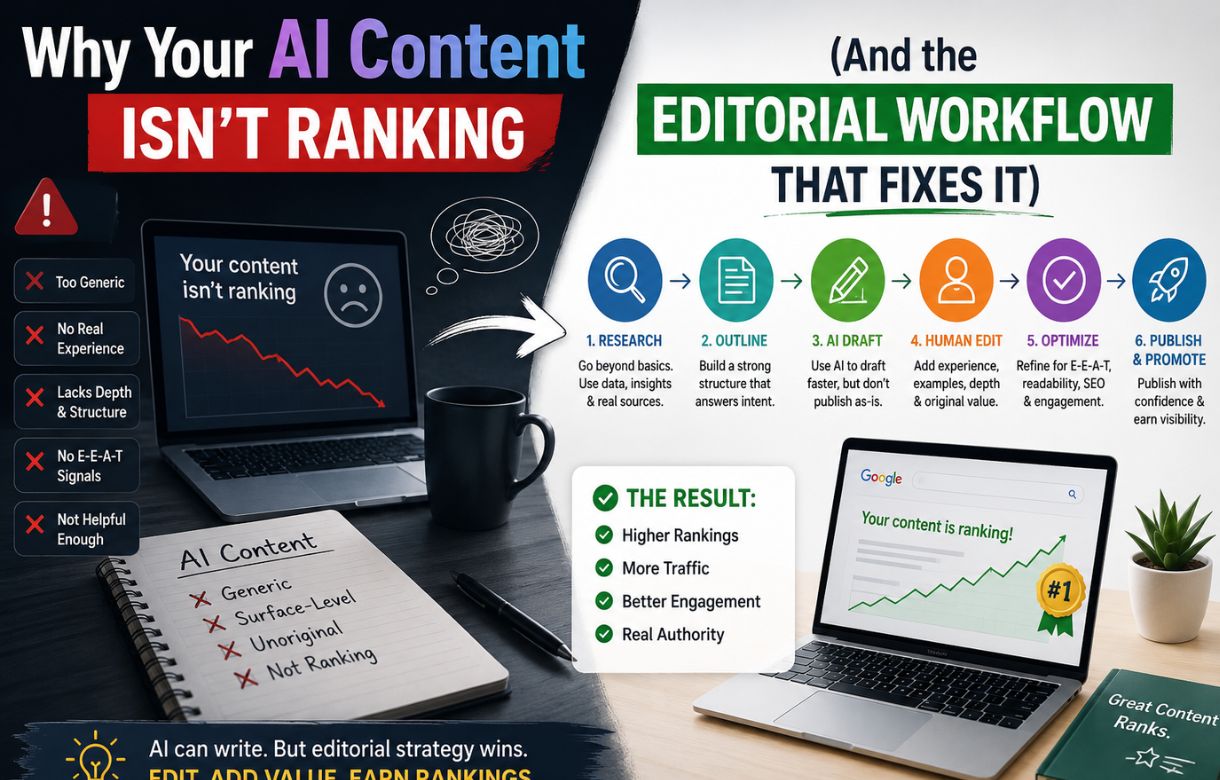
Put those two numbers together, and you get the actual thesis of this article: the gap isn’t between AI and humans. It’s between edited and unedited.
Why does Claude (and every other model) hallucinate in content?
What actually causes AI hallucinations?
A language model doesn’t “know” facts the way a search index does. It predicts the next most probable word based on patterns in training data. Ask it something well-represented and recent, and that prediction usually lines up with reality. Ask it for a specific statistic, a citation, or a quote it hasn’t actually seen enough times, and it fills the slot with the most plausible-sounding sequence instead of flagging the gap. Both outputs look identical on the page. That’s the whole problem in one sentence.
How often does this really happen?
It depends entirely on the task, which is exactly why you’ll see wildly different numbers floating around. On straightforward document summarization — where a model just needs to stay faithful to a source it’s already been given — the best models now hallucinate well under 1% of the time. Ask that same model to recall specific facts about a person, or generate a citation from memory instead of a provided source, and the rate can climb into double digits or higher. Task type moves the number far more than the model you pick.
That’s worth sitting with before you write a single line targeting “AI hallucination” as a topic: there’s no honest single percentage to quote. Any article claiming one clean number for “how often AI hallucinates” is already oversimplifying.
Why AI Content Doesn’t Rank — At a Glance
The gap isn’t AI vs. human. It’s edited vs. unedited. Here’s what the 2026 data actually shows.
The research layer — grounding a draft before you write it
This is the part that actually prevents hallucination and thinness at the same time, and it’s really four smaller habits, not four separate skills.
What does SERP analysis actually tell you?
Pull the top 10 to 15 pages already ranking for your target keyword before you write anything. You’re not reading them for ideas to copy — you’re reading them for patterns. What format wins here: listicle, long-form guide, comparison table? What length shows up repeatedly? What angle do the top three take that the rest don’t? SERP analysis is diagnostic, not inspirational. It tells you what Google has already decided this query wants.
How do you match search intent?
The SERP itself tells you the intent, whether or not you’ve thought about it directly. If the top results are all product pages, the query is commercial — a “best X” article probably won’t outrank them. If they’re all how-to guides, it’s informational, and a sales-y piece will struggle no matter how well it’s written. Search intent mismatch is one of the quiet reasons well-researched content still underperforms: the facts were right, but the format answered a different question than the one being asked.
What is entity SEO, in plain terms?
Entities are the specific people, brands, products, and concepts Google expects a topic to reference by name. A genuinely thorough article about home espresso machines doesn’t just describe “quality materials” — it names the actual brands, models, and comparison points a knowledgeable person would bring up unprompted. Entity coverage is one of the clearest tells between a draft that was researched and one that was generated from a vague sense of the topic. It’s also one of the easiest gaps to close: read the top-ranking pages and note every proper noun they mention that yours doesn’t.
Strong entity coverage does double duty in 2026, too — it’s one of the same signals that determine whether AI engines like ChatGPT cite a page at all, not just whether Google ranks it.
How do you run a content gap analysis?
Take the same 10 to 15 competitor pages from your SERP analysis and list every subheading each one covers. Build a simple grid: subtopics, articles, checkmarks. Anything 7 or more of the 10 competitors cover is table stakes — leave it out, and your article reads incomplete, no matter how well the rest is written. Anything with only one or two covers, especially if it answers a real “People Also Ask” question, is your differentiation opportunity. You don’t need a paid tool for this. A spreadsheet and twenty minutes do the job, and it doubles as your outline.
Humanizing the draft — the step most people skip
Most people treat “humanizing” as running a draft through a paraphrasing tool and calling it done. That’s not what closed the ranking gap in the 16-month study — the 4% figure came from substantive editorial work, not word-swapping. Here’s what that work actually looks like.
Why does AI writing sound like AI writing?
Before fixing it, it helps to name the pattern: sentences that all land at roughly the same length, transitions that over-explain themselves, and a conspicuous lack of genuine uncertainty. Every question gets a tidy, confident answer, even the ones that don’t have one. Read a paragraph back and ask whether a real person would actually sound that resolved about it.
How do you fix robotic sentence rhythm?
Vary the length on purpose. Let a short sentence sit next to a longer one. Break the subject-verb-object pattern that AI drafts default to — start a sentence with a clause, or a fragment, the way people actually write when they’re not being graded on grammar.
Why do contractions and asides matter more than people think?
“It’s” instead of “it is” sounds like a small thing and isn’t. A parenthetical aside, a mid-paragraph tangent that a real writer would naturally drop in — these are cheap to add and disproportionately effective at breaking the flattened, over-polished tone AI defaults to.
Should you ask questions in the middle of an article?
Not just in H3 headers for snippet targeting — inside body paragraphs too. A rhetorical question dropped mid-paragraph interrupts the “answer machine” cadence that gives AI writing away, and it reads as someone actually thinking through the topic in real time.
Why admitting what you don’t know builds more trust than filling every gap
This is the one people skip entirely. A line like “the company hasn’t confirmed this” or “it’s genuinely unclear whether that holds at scale” reads as more credible than an AI’s default habit of resolving everything neatly, because it is. This also directly undercuts the hallucination problem covered earlier — a model that’s never allowed to say “I’m not sure” is a model that fills the gap with something plausible-sounding instead.
Does first-person voice actually help AI content rank?
It correlates with the E-E-A-T signals the ranking studies keep circling back to — genuine expertise and editorial judgment, not just correct information. A first-person aside, a specific detail that only comes from having actually used or researched the thing, does work that no amount of correct facts alone can do.
How do you know if the humanization worked?
An AI detector score isn’t proof of quality — it’s a hygiene check, the same way a green RankMath score doesn’t mean an article is actually good. It just means nothing obvious is broken. Pair the detector pass with an actual re-read against the robotic-pattern checklist above. If you’re running this check across more than one article on the same topic in the same week, it’s worth reading them back to back — phrasing has a way of echoing itself piece by piece when a series is written close together, which is easy to miss when reading each piece in isolation. That’s a pattern worth watching for on any small content cluster, not just a single article.
The manual editing pass — five things to check before you publish
- Verify every statistic. If a number sounds suspiciously round or you can’t trace it to a specific source, cut it or replace it with something you’ve confirmed.
- Check every citation and quote. Confirm the source actually exists and actually says what’s attributed to it.
- Confirm intent match. Reread the piece against what the SERP is actually rewarding — format, depth, angle.
- Scan for AI-generic phrasing. Watch for the over-resolved, no-uncertainty tone flagged above.
- Sanity-check entity accuracy. Names, model numbers, dates — the details that are easy to get almost right and damaging to get slightly wrong.
FAQ
Does Google penalize AI-written content?
No, not for being AI-written specifically. Google’s own guidance focuses on content quality rather than how it was produced, and its spam policies target mass-produced, low-value content regardless of who or what wrote it. The penalty, functionally, falls on thin and unedited content — AI just makes thin, unedited content much faster to produce at scale.
Can you tell if the content was written by AI?
Sometimes, AI detectors are a reasonable first-pass signal, but they’re not definitive. The more reliable tell is usually the pattern described above: uniform sentence rhythm, no acknowledged uncertainty, everything resolved a little too neatly.
How much editing does AI content actually need?
Enough to close the gap between “technically accurate” and “genuinely useful.” In practice, that means a full fact-check pass, a rewrite for rhythm and voice, and a check against what’s actually ranking for the target query — not a five-minute skim
Is Claude accurate enough to write SEO content?
It’s accurate enough to draft from, not accurate enough to publish unverified. Hallucination rates vary enormously by task — very low on straightforward summarization, meaningfully higher on specific facts, citations, and figures pulled from memory. Treat any AI draft as a strong starting point that still needs a human fact-check pass before it goes live.