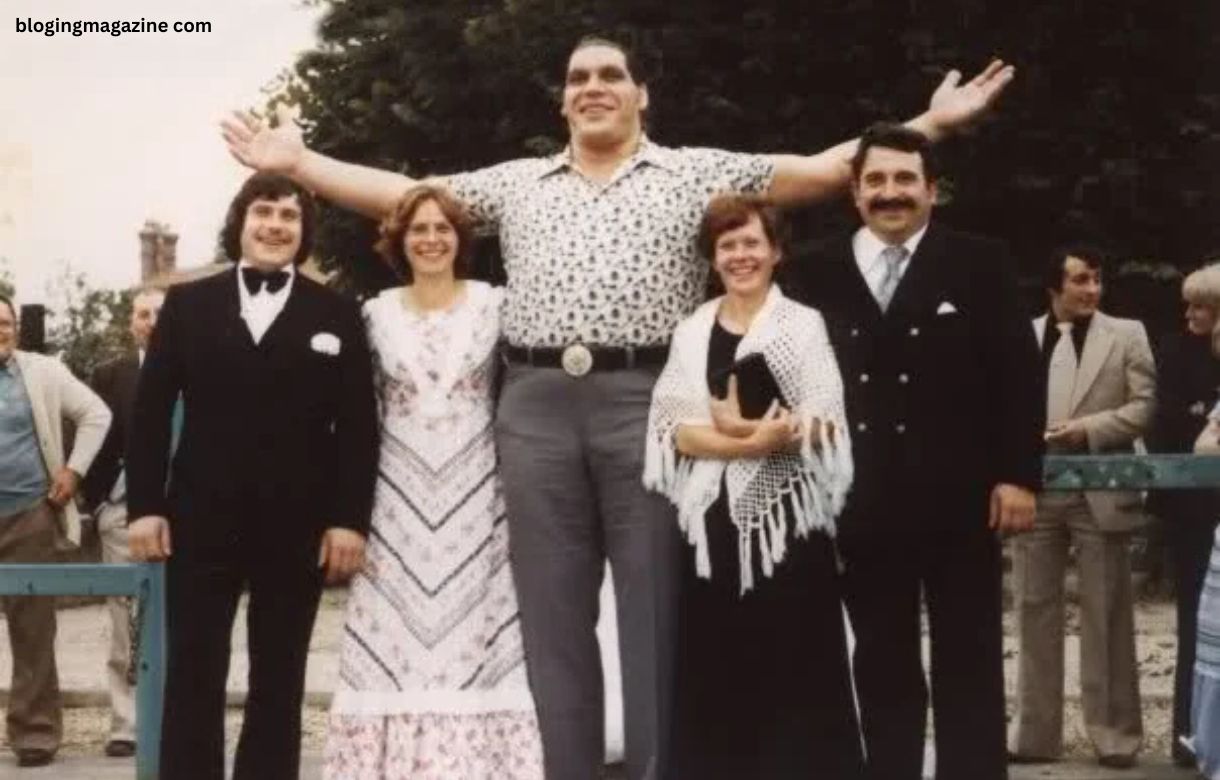
André René Roussimoff entered the world on May 19, 1946, in Coulommiers, France — arriving at a breathtaking 13 pounds, which was, perhaps, the first hint that nothing about his life would be small. His parents, Boris and Marian Roussimoff, were entirely ordinary in stature, as were his four siblings. The family settled in the rural village of Molien, roughly 40 miles east of Paris, where André spent his formative years surrounded by farmland and a quiet country life.
By the time he was 14, local law required him to leave school and join the workforce — a transition that coincided with his body beginning to change in ways nobody around him could fully explain. Within a year, he had already cleared 6'6". His size was making ordinary life complicated: catching a bus, fitting through doorways, finding clothes — all of it required workarounds that most people never think about. As he would later put it with characteristic simplicity, "They don't build anything for a giant."
Behind André's extraordinary size was a medical condition called acromegaly — a disorder rooted in a pituitary gland tumor that floods the body with excessive growth hormone. When this happens during childhood, it is classified as gigantism, producing the kind of skeletal and physical expansion that André experienced from his early teens onward. His head, hands, feet, and chest all grew well beyond normal proportions. He wore a size 22 shoe. A standard beer can, held in his palm, looked like something from a dollhouse.
He was not formally diagnosed until around age 24. When physicians presented surgery as an option, André declined — he had been told it could sideline or end his wrestling career, and that was a price he refused to pay. The decision came at a cost. His condition brought with it relentless, compounding pain: joint deterioration, cardiovascular strain, high blood pressure, diabetes, and spinal cord compression all took hold over the years. By the early 1990s, his body simply could no longer handle the demands of professional wrestling. He withdrew from the ring and retreated to his ranch in North Carolina, spending his final years in relative quiet, far from the roar of crowds that had defined so much of his life.
Robin Christensen-Roussimoff was born in 1979 and grew up in Seattle, largely under her mother's care. The father-daughter relationship was shaped by distance — both physical and emotional. André's grueling schedule kept him moving constantly, and when he was near Seattle for a match, those visits became precious. They stayed connected by phone. Robin has spoken about it with honesty and quiet longing: "Maybe had he lived longer, I might have had a closer relationship with him."
André ensured Robin was taken care of beyond his lifetime. He named her the primary beneficiary of his estate, and that arrangement endures — every time his image or name appears on WWE merchandise, Robin holds final approval and receives royalties. She still keeps some of her father's personal belongings, including the WWE Hall of Fame ring that was made in his honor. In 2018, she participated in HBO's documentary Andre the Giant, offering one of the most personal portraits of the man behind the legend.
In early January 1993, André flew to France to be present at his father's funeral. He chose to extend the visit to spend time with his mother on her birthday. On the morning of January 27–28, 1993, he was found unresponsive in his Paris hotel room. He had died peacefully in his sleep — the cause was congestive heart failure, a direct consequence of the acromegaly he had left untreated for decades. He was 46 years old.
In death, as in life, André's size presented one final logistical challenge: he had wished to be cremated, but no facility in France had equipment large enough. His body was transported back to the United States. His ashes were eventually scattered across his ranch in Ellerbe, North Carolina — the patch of land he had loved most.
Nobel Prize-winning playwright Samuel Beckett — the mind behind Waiting for Godot — happened to own a plot of land in France neighboring the Roussimoff family farm. Even as a young boy, André's condition had already made him too large to ride the school bus. When Beckett learned of the problem, he stepped in without fanfare, offering André a seat in his truck each morning. The two developed an unlikely friendship built around cricket and conversation. Some believe Beckett quietly kindled André's love of theater — though André himself never attended a performance, convinced his presence would obstruct the view of everyone seated behind him.
When André was called up for French military service in 1965, the army was entirely unprepared for what walked through the door. No standard-issue uniform came close to fitting him. The bunks couldn't support his frame. And when it came to trench combat — still a foundational element of military training at the time — there was simply no trench wide or deep enough to contain him. The military, apparently at a loss, thanked André for his time and sent him back home.
His role as the gentle giant Fezzik in The Princess Bride (1987) is the one most people remember — but André's screen career was broader than that. He played the villain Dagoth in Conan the Barbarian without a credit to his name, and made guest appearances on popular TV shows of the era including The Greatest American Hero and BJ and the Bear. Arnold Schwarzenegger, his co-star on Conan, was originally slated to play Fezzik in an earlier, aborted version of The Princess Bride — because at that stage, André was simply too in-demand as a wrestler to commit to a film. After André's passing, his friend Billy Crystal paid tribute by producing My Giant, a film directly inspired by the bond the two had formed on set.
André reportedly consumed upward of 7,000 calories worth of alcohol on a given day — a figure that earned him the informal, somewhat awed title of "Greatest Drunk on Earth." Stories of him finishing over a hundred beers in a single sitting, or draining several bottles of wine without visible effect, circulated among wrestlers and promoters for decades. But the truth beneath the legend was darker: André used alcohol to manage the chronic, grinding pain his condition inflicted on his body every day. Drinking was not recreation — it was the only relief he had access to.
In 1974, André's name appeared in the Guinness Book of World Records — not for his height or his weight, but for his earnings. He was officially the highest-paid professional wrestler on the planet, taking home approximately $400,000 per year (a figure that translates to roughly $2 million in today's money). The income was substantial, but so were the costs of his life: custom-built clothing and furniture, modified accommodations, multiple airline seats per flight, and bar tabs that would have made a lesser person reconsider their lifestyle choices.
For all the money that passed through André's hands, he was known as one of the most generous men in the business. If you went out to eat or drink with André, you did not pay — end of discussion. Arnold Schwarzenegger, dining with him once, tried to quietly cover the check while André was occupied elsewhere. When André discovered what had happened, he enlisted Wilt Chamberlain — another man not exactly built for subtlety — and the two of them lifted Schwarzenegger off his feet and deposited him on the roof of his own car. The message was clear: André pays.
André was billed at 7'4" — an imposing figure by any measure — but wrestling history includes a handful of men who stood taller. Among them was Giant Gonzalez, a former NBA player who competed in both WCW and WWE and measured in at 7'7". Like André, Gonzalez suffered from a similar hormonal condition, and he died in 2010 from diabetic complications related to it. Raw height, however, never told the full story of André's size — he weighed over 500 pounds at the peak of his career, and his cremated remains, according to those present, tipped the scales at more than 17 pounds.
André never married, and his only child — Robin Christensen-Roussimoff — has navigated the unusual experience of being the daughter of a global icon largely from a distance. She has spoken candidly about how her father's fame complicated her personal life, including the near-impossibility of dating when prospective partners discovered whose daughter she was. She has also made her feelings known about the famous "OBEY" street art silhouette of André, which was created and distributed without her family's permission. Robin remains connected to her father's legacy through WWE royalties and approval rights — but entirely on her own terms.
WWE built enormous promotional heat around the idea that André had gone undefeated for fifteen years before finally losing to Hulk Hogan at WrestleMania III — but the historical record tells a different story. André had in fact lost matches and wrestled to draws several times over the years leading up to that event. The claim that Hogan was the first man to bodyslam him was also fiction: the move had been performed on André more than a dozen times before that night. Hogan himself had once body-slammed André during his early, villainous run in the WWF, wrestling against André as the fan favorite. In the pre-internet era, myths like these had room to breathe — and it did make for a far better story.
Following André's death in January 1993, WWE created its Hall of Fame — and chose him as its inaugural inductee, the only member of the first class. There was no grand ceremony: a video tribute aired on Monday Night Raw, and that was that. WWE added three more Hall of Fame classes over the following years before putting the concept on hold, eventually reviving it in 2004 as the elaborate WrestleMania weekend tradition it remains today. In 2014, for the thirtieth anniversary of WrestleMania, WWE introduced the André the Giant Memorial Trophy — presented annually to the winner of a dedicated battle royal — ensuring his name continues to echo through arenas long after he left them.