Anyone trying to get better at paid search runs into the same problem fast: there’s too much to follow. Dozens of blogs, dozens of newsletters, a handful of active communities, all claiming to be the place that’ll keep you sharp. Subscribing to everything isn’t a strategy — it’s just a slower way of learning nothing well.
The three formats aren’t interchangeable, even though they all get lumped under “PPC resources.” Each one is actually built for a different kind of learning, and picking the wrong one for what you need is why a lot of subscriptions go unread.
What Is a PPC Blog Actually Good For?
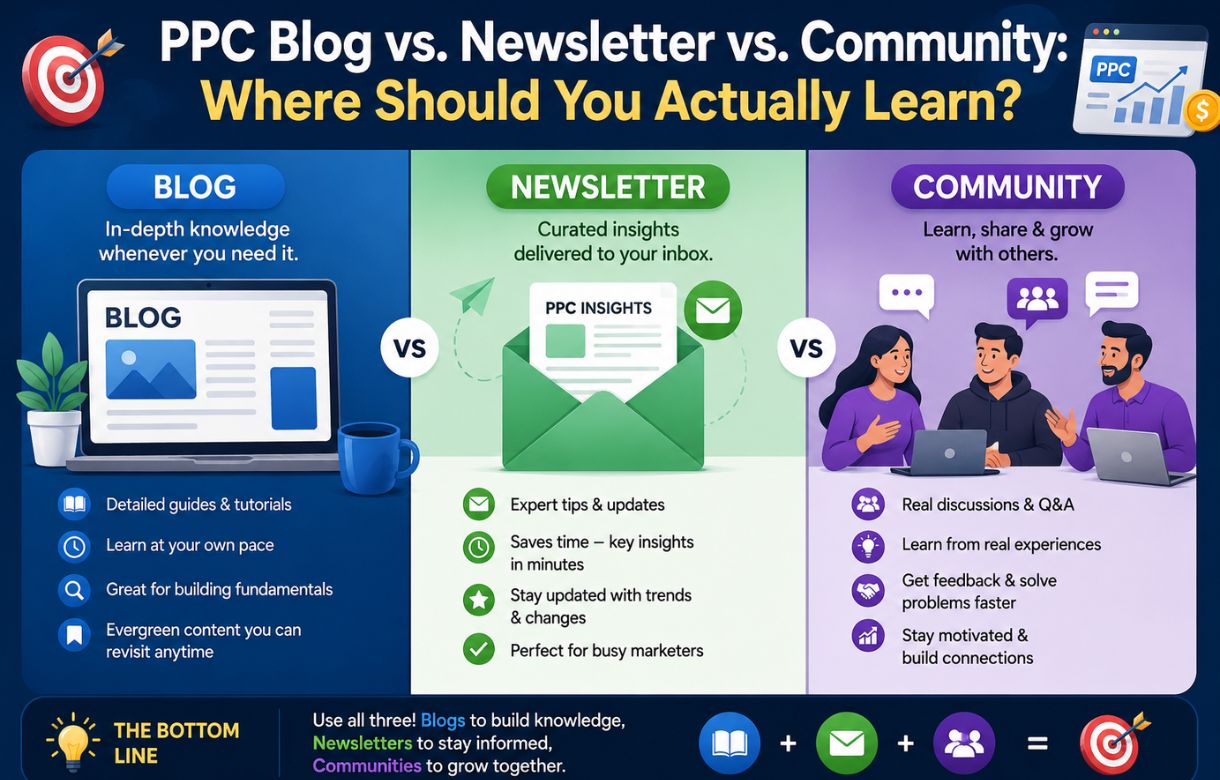
Depth and reference. A blog post can walk through a full campaign structure, break down a real case study with numbers, or explain a concept in enough detail that you can come back to it later as a reference. Sites like PPC Hero, WordStream, and Search Engine Journal built their audiences on exactly this — long-form, searchable, evergreen explanations of how things work.
The tradeoff is speed. A blog post takes time to write, edit, and publish, so by the time something shows up as a full article, it’s rarely the first place you’ll hear about a platform change. Blogs are where you go to understand something thoroughly, not to catch it the moment it happens.
What Is a PPC Newsletter Actually Good For?
Speed and curation. A newsletter’s whole job is telling you what changed this week and why it matters, without making you go find it yourself. Something like PPC News Feed exists almost entirely for this — compressed updates on platform changes, policy shifts, and algorithm news, delivered before most blogs have written a full post about it.
The tradeoff is depth. A newsletter item is a paragraph, maybe a few, not a full breakdown. It tells you a Google Ads feature changed; it usually doesn’t walk you through exactly how to restructure a campaign around it. Newsletters are for staying current, not for building foundational knowledge.
What Is a PPC Community Actually Good For?
Specific, real-time troubleshooting, and a read on what other practitioners are actually seeing — not just what’s been officially announced. A subreddit like r/PPC, or a Slack group built around it, is where you post “has anyone else seen Performance Max tank like this in the last week” and get answers from people looking at their own dashboards right now, not a general explainer written for a broad audience.
The tradeoff is signal quality. Communities are unfiltered by design — you’re getting individual anecdotes, not vetted analysis, and the same question can pull five confident, contradictory answers depending on who’s online that day. A community is for pattern-matching against other people’s real accounts, not for treating any single answer as verified fact.
How Do These Three Actually Work Together?
In practice, they cover different points in the same cycle. A platform change happens; a newsletter tells you it happened, fast and short. A community fills in what real accounts are actually experiencing with it, in real time, before anyone’s had time to write a considered take. A blog post, days or weeks later, does the deeper analysis — what actually worked, what the data showed, how to adjust strategy for it.
Treating any one of them as sufficient on its own means missing a piece of that cycle. Relying only on newsletters means you know what changed but not how to react to it. Relying only on a community means you get fast reactions but no reliable depth. Relying only on blogs means you’re always a few weeks behind on anything time-sensitive.
If You Can Only Pick One, Which Should It Be?
It depends on where you actually are. If you’re new to PPC and building foundational knowledge, start with blogs — you need the depth before the speed matters. If you’re already managing accounts and mostly need to stay current without drowning in noise, a well-curated newsletter earns its place in your inbox. If you’re actively troubleshooting live campaigns and want to know what other real accounts are seeing right now, a community beats both.
Most people who feel overwhelmed by PPC content aren’t actually following too many sources — they’re following the wrong one for the problem they currently have.
Is It Worth Following More Than One of Each?
Rarely, past a certain point. One solid reference blog, one curated newsletter, and one active community cover the three functions above without redundancy. Adding a second or third blog covering the same ground mostly just duplicates content you’ve already half-read somewhere else — the diminishing returns kick in fast once the first source in each category is doing its job.
The better use of that extra time is usually depth, not breadth: actually reading the one good explainer thoroughly, instead of skimming five versions of the same advice from five different publishers.
If you’re specifically weighing whether to start publishing rather than just consume, How to Start a PPC Blog (What Actually Works, Not Just a Publishing Schedule) covers the positioning problem that determines whether a new blog stands a chance. And if your reference-blog category needs filling in, Best PPC Blogs for Small Business Owners (Not Agencies) is a shorter, more filtered starting point than the usual roundups.
Frequently Asked Questions
Are PPC newsletters better than blogs for beginners?
Not for foundational learning. Newsletters assume you already understand the basics and just need updates layered on top. A beginner generally gets more value starting with blog-length explainers before switching to a newsletter for ongoing updates.
Is r/PPC a reliable source of PPC advice?
It’s reliable for real-time, practitioner-level pattern-matching — what other people are actually seeing in their accounts — but individual answers aren’t vetted the way a published article is. Treat community answers as data points to compare against your own results, not as verified best practice on their own.
How many PPC newsletters should you actually subscribe to?
Usually one or two is enough to stay current without redundancy. Past that, most newsletters are reporting on the same handful of platform changes each week, just with different framing
Do PPC communities replace the need to read blogs at all?
No — they answer different questions. A community can tell you what’s happening right now in real accounts; it generally can’t replace a well-structured explainer when you need to actually learn how something works from the ground up.