
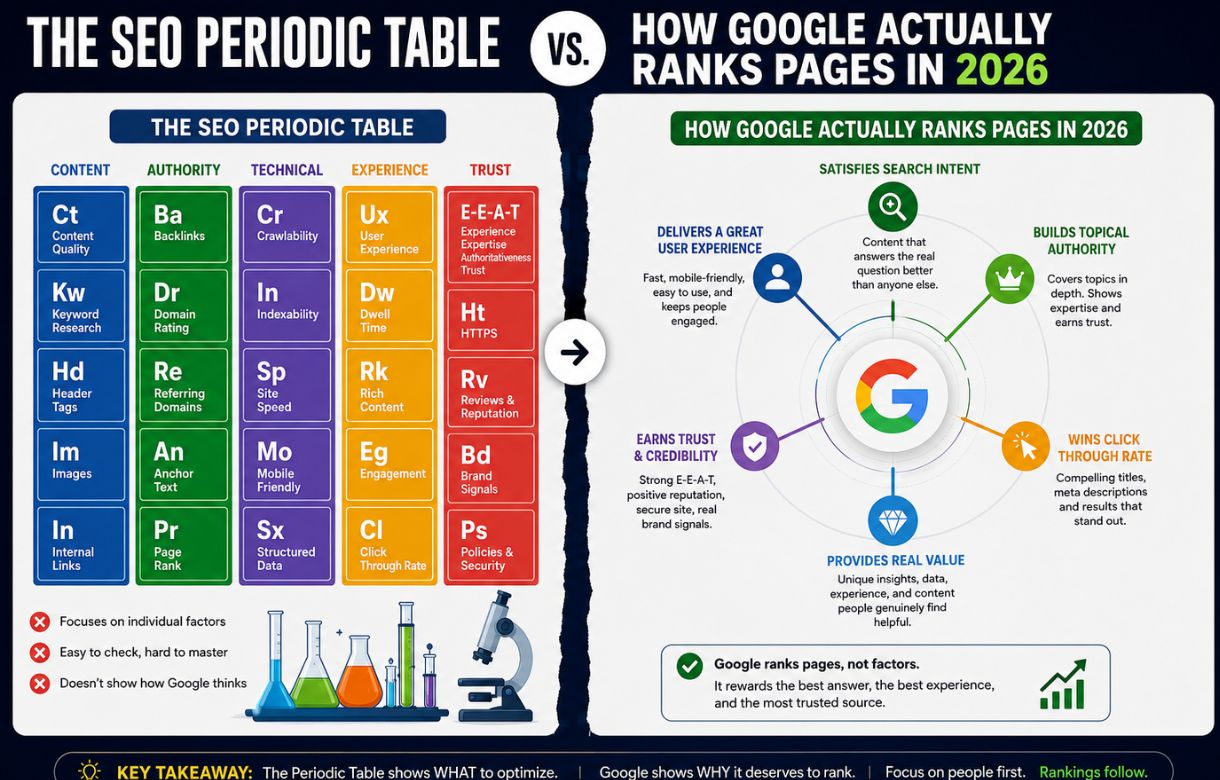
If you’ve spent any time in SEO circles, you’ve seen it: a chemistry-class-style grid of ranking factors, sorted into tidy groups like Content, Links, and Trust. It’s been shared in decks, embedded in blog posts, and quoted in client onboarding calls for over a decade.
It’s also, in places, out of date. Not wrong, exactly. Just built for a search engine that no longer fully exists.
This isn’t a takedown. The framework still teaches the fundamentals better than most modern content does. But if you’re using it as a literal checklist in 2026, you’re missing half the picture — the half that determines whether you show up in an AI Overview, get cited as an entity, or get quietly filtered out by a helpful content system the original table never accounted for.
What Is the SEO Periodic Table, Exactly?
The concept started with Search Engine Land, which organized ranking factors into element groups the way chemistry organizes atoms — not because SEO and chemistry have anything in common, but because the metaphor made a sprawling, intimidating topic feel structured and learnable.
The groups have shifted slightly over the years, but the core buckets have stayed consistent: content, site architecture, code-level technical health, credibility signals, links, user experience, and page performance. Each “element” inside those groups represents a specific thing you can act on — page titles, crawlability, author bios, backlink quality, load speed, and so on.
It’s a teaching tool first, a checklist second. That distinction matters more than most people give it credit for.
Why Did This Framework Take Off in the First Place?
Because SEO used to feel like folklore. Practitioners traded rumors about what Google “liked,” agencies guarded their processes like trade secrets, and there was no widely accepted way to explain ranking factors to a client who’d never touched Search Console.
The periodic table solved that. It gave marketers a shared vocabulary and a visual that made sense to non-technical stakeholders in a single glance. You didn’t need to understand PageRank math to understand that “links” was a category and “quality” mattered within it.
That’s still valuable. Onboarding a junior writer or a skeptical client benefits from a framework, not a 90-minute lecture on crawl budgets.
It’s worth noting that the “architecture” group in the table is really a simplified stand-in for a much bigger decision: how you structure topics across a site so search engines understand what you’re actually an authority on. That’s a separate, deeper problem than any single element on the chart can capture — closer to what building a small content cluster actually takes for a solo publisher than to any single line item on a chart.
Which Parts of It Still Hold Up?
Most of it, honestly. The categories aren’t wrong — they’re incomplete.
Content quality is still the foundation. Sites still need to be crawlable. Backlinks still function as a trust signal, even as their relative weight shifts. Page experience — speed, mobile usability, intrusive interstitials — still affects both rankings and whether anyone sticks around to read what you wrote.
Where the table starts showing its age isn’t in what it includes. It’s in what didn’t exist yet when the categories were drawn up.
What’s Missing From a Framework Built for an Earlier Search Engine?
Three things, mainly.
First, the table treats “credibility” largely as author bios, citations, and brand mentions — reputation signals a human reader would recognize. It doesn’t account for how search engines now assess whether an entity (a person, brand, or organization) is consistently represented and cross-referenced across the web, independent of any single page’s on-site signals.
Second, it has no real category for how content gets evaluated relative to what already exists on a topic. Helpful content systems increasingly reward pages that close a genuine information gap rather than restating what the top ten results already say. That’s a different skill than “content quality” as originally defined — it’s closer to the kind of systematic content gap analysis that identifies exactly what competitors left out, and builds around that instead of around keyword volume alone.
Third, and most obviously: generative search results. When an AI Overview or a chat-based assistant answers a query directly, ranking in the traditional ten blue links sense stops being the only goal. Getting cited as a source inside that generated answer depends on factors — structured, extractable, unambiguous statements; clear entity association; content that answers a question in a self-contained way — that the original table simply never had a slot for.
How Does Entity SEO Fit Into an Element-Based Model?
Entity SEO is really asking a different question than the periodic table was built to answer. The table asks: does this page have the right ingredients? Entity-based ranking asks: does the web agree on who or what is behind this content, and is that identity consistent everywhere it appears?
That’s less about any single page’s optimization and more about whether your brand, your authors, and your organization show up the same way across your site, your social profiles, review platforms, and third-party mentions. A page can hit every box in the “Content” and “Code” groups and still underperform if the entity behind it has no established footprint elsewhere.
Does It Account for AI Overviews and Generative Search at All?
Not really — and that’s not a criticism of whoever maintains the table today; it’s just a timeline problem. Generative search results didn’t exist in a form worth planning for until years after the framework was popularized.
What’s changed practically: search visibility is no longer a single outcome. A page can rank on page one, get pulled into a generated answer, or do both, or neither, and each of those outcomes rewards a slightly different combination of clarity, structure, and source credibility. A checklist built around “get more backlinks, improve load time, write better titles” doesn’t tell you how to write a paragraph an AI system can lift cleanly and attribute correctly.
This is exactly the gap that’s pushed some SEO agencies to formalize generative engine optimization as its own service line, separate from traditional rank tracking — because the skill set for getting cited inside an AI-generated answer isn’t quite the same one that gets a page to position one.
So How Should You Actually Use the Table in 2026?
As a floor, not a ceiling.
Use it to make sure the fundamentals are covered — technical health, structured content, reasonable page speed, some link authority. Those things haven’t stopped mattering. Skipping them still hurts you.
Then treat everything past that as a separate, newer layer: build a consistent entity presence across platforms, write content that closes a real gap rather than restating a competitor’s outline, and structure key facts so they’re easy for both humans and AI systems to extract cleanly. None of that fits neatly into a seven-group chemistry metaphor, and that’s fine. Frameworks age. The goal was always to rank well and earn trust — the table was just one era’s best attempt at explaining how.
Frequently Asked Questions
Is the SEO periodic table still accurate today?
Largely, yes, for the fundamentals it covers — content quality, technical crawlability, links, and user experience are all still relevant. It’s incomplete rather than wrong, missing newer concepts like entity consistency and generative search visibility that didn’t exist when the framework was built.
Who originally created the SEO periodic table?
Search Engine Land introduced the concept, organizing ranking factors into element groups modeled on the periodic table of elements to make SEO easier to teach and explain to non-specialists.
Does ranking well in the periodic table’s categories guarantee visibility in AI Overviews?
No. Traditional ranking factors help, but visibility inside generated AI answers depends more on clear, self-contained, extractable statements and consistent entity signals — categories the original framework doesn’t directly address.
Does ranking well in the periodic table’s categories guarantee visibility in AI Overviews?
No. Traditional ranking factors help, but visibility inside generated AI answers depends more on clear, self-contained, extractable statements and consistent entity signals — categories the original framework doesn’t directly address.
What should replace the periodic table as a planning framework?
Nothing needs to fully replace it — it’s still a reasonable starting checklist. The more useful approach is layering entity consistency, content gap analysis, and AI-extractability on top of it, rather than discarding the fundamentals it already gets right.

Appreciate this post. Will try it out.
Greate pieces. Keep writing such kind of info on your blog.
Im really impressed by your blog.
Hello there, You’ve performed an excellent job. I’ll certainly digg it and in my view suggest to my friends.
I’m sure they’ll be benefited from this website.
Do you have any video of that? I’d love to find
out some additional information.
It is not my first time to visit this web site, i am browsing this web page dailly and obtain pleasant information from here
daily.
I seriously love your website.. Great colors & theme.
Did you create this website yourself? Please reply back as
I’m planning to create my own personal site and want to learn where you got this from or exactly what the theme is called.
Appreciate it!
Yes, I have created it by myself
It’s really very difficult in this full of activity life to listen news on Television, therefore I just use world
wide web for that purpose, and obtain the hottest news.
I have been surfing online more than 4 hours today, yet
I never found any interesting article like yours.
It’s pretty worth enough for me. In my view, if all webmasters and bloggers
made good content as you did, the net will be a lot more useful than ever before.