If you’ve searched this question, I already know what you’ve read. Check your robots.txt. Submit your sitemap. Be patient; it takes six months. Build backlinks. All true, all generic, and none of it tells you what’s actually happening on your site.
So instead of repeating that advice, I’m going to show you my own Search Console data from the last two months and walk through what it actually means — because the diagnosis most people jump to first (“Google is ignoring me”) usually isn’t the real problem. This is the part the SEO roadmap for beginners didn’t have room for: what the “quiet months” it warns about actually look like in a real dashboard, not just in theory.
Wait, Is My Site Even Being Indexed?
This is the first question to answer, and it’s the one most “why isn’t my blog ranking” articles skip entirely — they assume you’re starting from zero visibility.
My domain is two years old, but I only started publishing on a regular, consistent schedule two months ago. In that window, I’ve put out 70 to 75 articles and built up 215 backlinks. Sitemap submitted, robots.txt checked and clean.
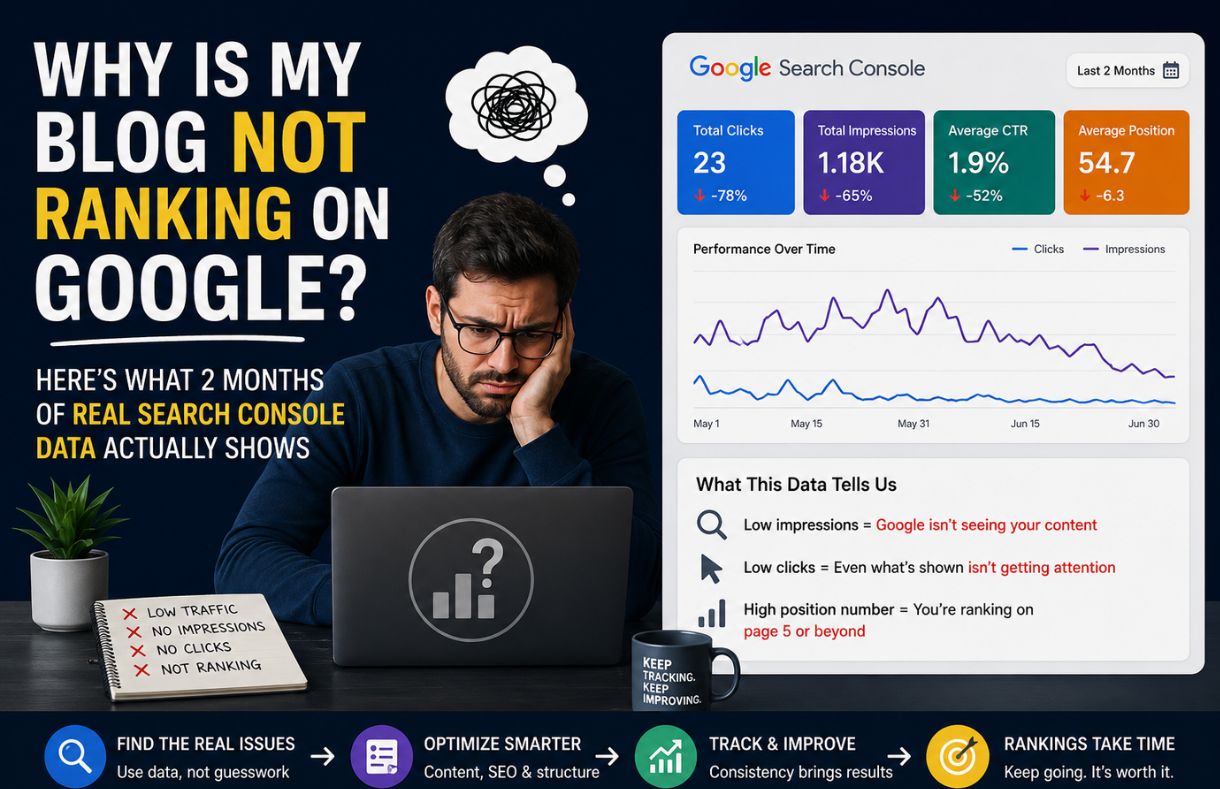
Here’s what my impressions graph looks like over that period: flat at zero through late April, then a climb starting mid-May, a cluster of spikes through June, and a peak of roughly 400+ impressions in a single day around June 12. Impressions have stayed active since, bouncing between 50 and 150 most days.
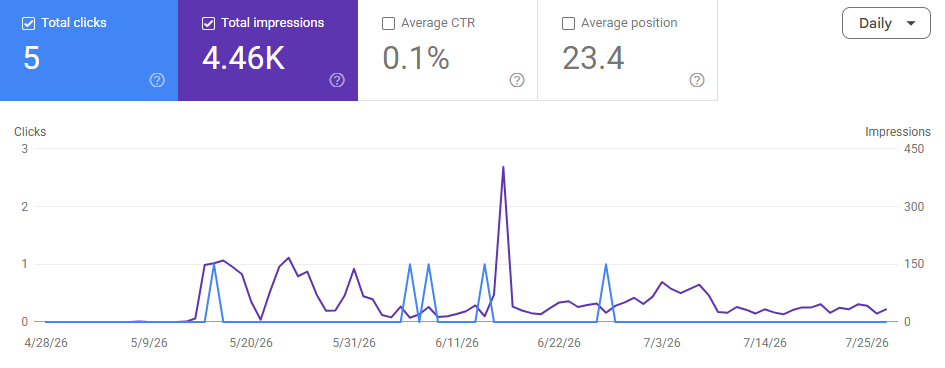
My actual Search Console performance report — two months of consistent publishing.
That graph answers the indexing question by itself. If your pages weren’t indexed, you wouldn’t have impressions at all — impressions only happen when Google has crawled a page, understood it enough to associate it with a query, and decided it’s relevant enough to show, even briefly, somewhere in the results. Zero indexing looks like a flat line at zero, full stop. Mine doesn’t look like that anymore. If the difference between an impression, a click, and position still feels fuzzy, Google Search Console for beginners breaks down what each number is actually measuring before you try to diagnose anything from them.
So if you’re seeing any impressions in your own report, you can stop worrying about indexing and start looking at the actual gap — which is where mine gets interesting.
Then Why Aren’t Impressions Turning Into Clicks?
This is the real story in my data, and it’s a much more common situation than the “not indexed” narrative that dominates most advice on this topic.
My clicks line barely moves. It sits at zero for most of the graph, with occasional single-day spikes to 1, 2, or even 3 clicks — completely disconnected from the impressions climbing in the background. On the day impressions hit their 400+ peak, clicks didn’t spike anywhere close to proportionally.
That gap between impressions and clicks almost always comes down to one of two things: average position, or how the listing looks once someone sees it.
Position. Impressions get logged no matter where you rank — position 8, position 40, doesn’t matter, Google still counts it as an impression if your page appeared anywhere in results for that query. Most new content, even when indexed, lands somewhere between page 2 and page 5 at first. People rarely click past page 1. So you can rack up impressions for weeks while sitting in positions nobody scrolls to.
Title and snippet appeal. Even a page 1 impression doesn’t guarantee a click if the title tag doesn’t match what the searcher actually wants, or the meta description reads like it was written for a search engine instead of a person.
Since I can’t fully separate these two without digging into the Performance report by query and checking average position per page, that’s the next thing I’m doing — and it’s the next real step for anyone seeing this same impressions-without-clicks pattern.
Does a 2-Year-Old Domain Actually Help Here?
Somewhat, but not the way people assume.
Domain age by itself isn’t a ranking factor Google has confirmed using directly. What actually seems to matter is accumulated trust — consistent publishing history, backlink profile, and a track record of content that doesn’t get pulled down or heavily edited after the fact. A domain that’s existed for two years but sat mostly dormant doesn’t carry much more weight than a brand-new one once you start actively publishing again.
That’s roughly what my data suggests too. The real inflection point on my impressions graph lines up with when I started publishing consistently two months ago — not with the domain’s two-year age. So if you’ve got an older, quiet domain and you’re about to start posting regularly, don’t expect the domain age alone to fast-track anything. The consistency is what’s doing the work.
Is 215 Backlinks Enough?
Numbers alone don’t answer this — quality and relevance do more work than volume. 215 backlinks from niche-relevant, moderately authoritative sites will outperform 500 from low-quality directories or irrelevant sites every time.
What I can say from my own graph: backlinks likely aren’t the current bottleneck. If backlinks were the missing piece, I’d expect to still be seeing close to zero impressions, since backlinks primarily influence authority and ranking position rather than indexing and initial visibility. The fact that impressions are climbing suggests the backlink profile is doing enough to get pages discovered and considered. The click gap points toward position and on-page appeal being the more immediate problem to fix, not link building.
What Two Months of Consistent Publishing Actually Buys You
If you’re one or two months into consistent publishing and comparing your graph to mine, here’s the honest expectation: this stage is about proving to Google that your site is active and worth crawling and evaluating regularly — not about ranking on page 1.
Impressions climbing while clicks stay flat is a normal, even encouraging, part of that process. It means your content is entering the evaluation pool. What happens over the next few months — whether those impressions convert into clicks and whether average position improves — depends on the follow-up work: refining titles and descriptions on pages already getting impressions, checking which queries you’re showing up for versus which you’re actually trying to target, and continuing to publish consistently rather than stalling out. That mismatch between the queries you’re actually getting impressions for and the ones you set out to target is worth checking directly in your Queries report — it’s one of the free signals keyword research for beginners points to as more reliable than guessing from a tool.
What I’m Changing Going Forward
Based on what this data actually shows, here’s where I’m putting effort next, rather than guessing:
Going into Search Console’s Performance report and sorting by impressions to find pages getting visibility but zero or near-zero clicks. Those are the pages where a title and meta description rewrite could have immediate impact, since the content is already being surfaced.
Checking average position on those same pages. If they’re sitting at position 15+, that’s a content depth or relevance problem worth revisiting. If they’re closer to position 5–10, that’s much more likely a title/snippet appeal problem I can fix without touching the article itself.
Not touching the backlink strategy for now, since the data doesn’t point there as the current constraint.
FAQ
How long does it take a new blog to start ranking on Google?
Most sites see little to no visibility for the first few months, even with consistent publishing and clean technical SEO. Meaningful ranking movement more commonly shows up between month four and month twelve, and can take longer on more competitive topics.
Is it normal to have impressions but no clicks?
Yes, especially in the first few months of consistent publishing. It usually means pages are indexed and being surfaced for some queries, but sitting in a position or with a listing that isn’t compelling enough to earn clicks yet.
Does domain age matter for ranking?
Not directly. What matters more is a consistent, active publishing history and an accumulated trust signal built over time — an old but dormant domain doesn’t carry much advantage over a new one once regular publishing starts.
How many backlinks does a new blog need?
There’s no fixed number. A smaller set of relevant, moderately authoritative backlinks generally outperforms a larger set of low-quality or irrelevant ones.