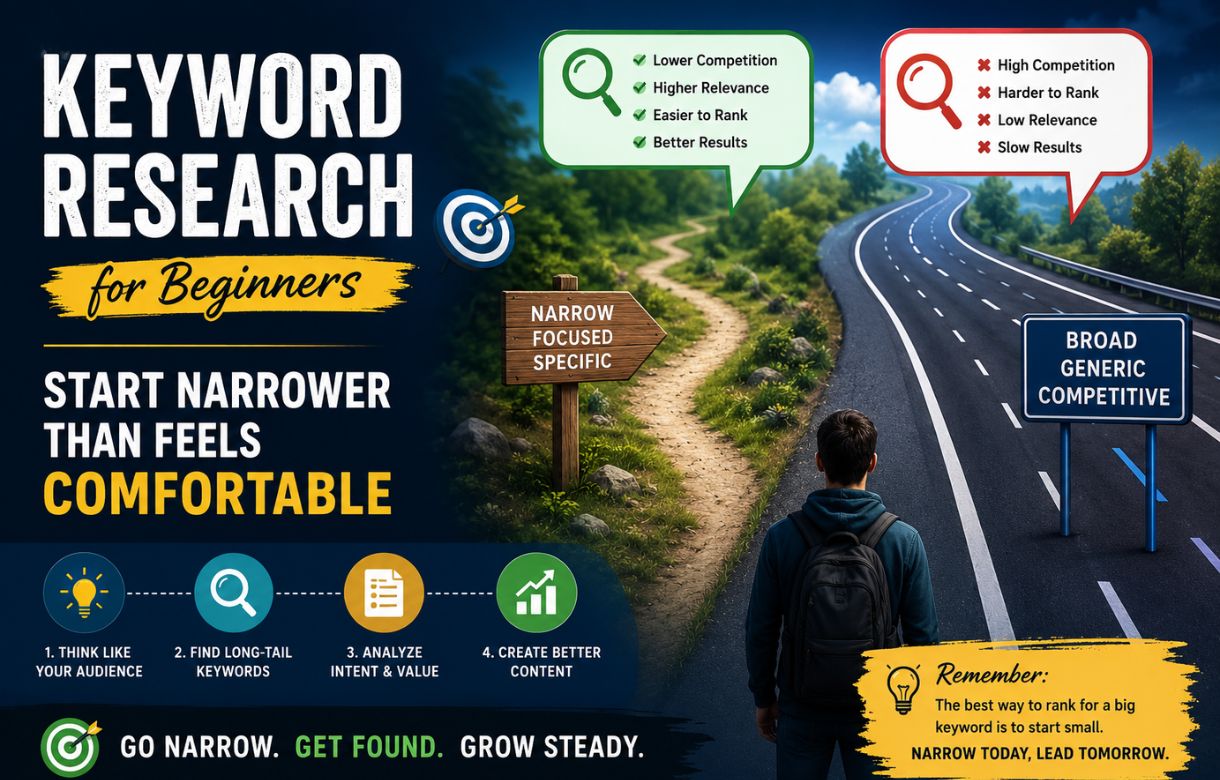
Most keyword research advice for beginners starts with a tool. Open this, type in a seed word, sort by volume. The problem isn’t that this is wrong — it’s that it skips the one decision that actually determines whether a new site has a chance: picking something narrow enough to win, before worrying about how to find more of it. That’s the idea the SEO roadmap for beginners stakes out early on — start narrower than feels comfortable. This is where that turns into an actual process.
What makes a keyword good for a beginner site?
Not volume. Low competition paired with clear intent.
A keyword with huge search volume and a page one full of established sites isn’t an opportunity, it’s a wall. A keyword with modest volume, an obvious “here’s what the person actually wants,” and a page one that’s thin, outdated, or written by nobody with real experience — that’s winnable. For a new site with no authority yet, winnable beats big every time.
This is the opposite instinct from what most people bring into keyword research. High numbers feel like proof of opportunity. In practice, they’re usually proof of competition you can’t beat yet.
How do you find long-tail keywords without expensive tools?
Type into Google and read what it hands you back before you type anything into a keyword tool.
Autocomplete shows real phrases people are already typing — not guesses, actual queries. The “People Also Ask” box on a results page is a free list of related questions, and clicking one usually expands into more. Scroll to the bottom of any results page, and “related searches” adds another layer of phrasing you might not have thought to try. None of this costs anything, and all of it comes directly from Google rather than a third party’s estimate.
Once you have Search Console running — which should already be true, since it comes before this step — there’s a source that beats all three: the “Queries” report shows you what people are already searching to find your existing pages, including terms you never intentionally targeted. That’s not hypothetical demand; that’s proof of a searcher who already found you by accident. Building deliberately around that is one of the few keyword methods that’s closer to lab data than guesswork.
How do you tell if a keyword is too competitive for you right now?
Look at who’s already ranking, not just how many people search it.
If the top results are established publications, major brands, or sites with years of built-up authority, a new post from a young site isn’t dislodging them anytime soon, regardless of how well it’s written. If the top results are thin, generic, outdated, or clearly written to hit a keyword rather than answer a question — that’s a real opening, even if the search volume looks small.
This is a judgment call more than a number, and it’s the one step a spreadsheet can’t fully do for you. It requires actually looking at the search results, not just the metrics beside the keyword.
What does search intent actually mean, and how do you check it?
Key Facts: Keyword Research for Beginners
-
Low competition beats high volume, early on
A modest-volume keyword with a thin page one is winnable. A huge-volume keyword with established sites on page one usually isn’t yet.
-
Free discovery methods cover the fundamentals
Autocomplete, “People Also Ask,” related searches, and your own Search Console → Queries report — no paid tool required to start.
-
Check intent by reading what’s already ranking
Google’s current page one is its best guess at intent, already tested against real user behavior. Match that shape.
-
Competitiveness is a judgment call, not just a number
Look at who’s ranking, not only the difficulty score. Thin or outdated top results signal a real opening.
-
One primary keyword per article, not ten
A page built around one clear question, with a few naturally related terms, outperforms a page stretched thin across many.
It’s the reason behind the search — not just the words, but what the person wants once they click.
The same surface-level topic splits into different intents depending on phrasing. Someone searching for “what is content cluster strategy” wants an explanation. Someone searching for “content cluster strategy tools” is closer to choosing a product. Writing an explainer for someone who wants to make a buying decision, or vice versa, means the content might rank and still fail to satisfy anyone who lands on it — which eventually shows up as high impressions and low engagement.
The fastest way to check intent isn’t a framework; it’s looking at what’s already ranking for that exact term. If page one is full of guides and explainers, the intent is informational. If it’s full of product pages and comparison posts, it’s commercial. Google has already done the interpretation work for you — the current results are Google’s best guess at intent, tested against real user behavior. Matching that shape is more reliable than guessing from the keyword alone.
How many keywords should one article target?
One primary, a small handful of naturally related secondary terms. Not a list to check off.
Trying to hit ten unrelated keyword phrases in a single article usually produces something that serves none of them well — too broad to fully answer any one intent, too scattered to read like it was written for a specific person with a specific question. A page built around one clear question, using the natural vocabulary a reader and a search engine would both expect around that topic, tends to outperform a page stretched thin trying to catch everything at once. This is one part of the on-page SEO checklist. To get a complete on-page SEO checklist or guidance, explore the article On-Page SEO for Beginners: A Shape, Not a Checklist.
FAQ
Do you need a paid keyword tool to start?
No. Autocomplete, “People Also Ask,” related searches, and your own Search Console queries cover the fundamentals for free. Paid tools add convenience and scale once you’re managing dozens of articles and need to compare metrics quickly — they’re not what makes early keyword research work.
What’s a good search volume for a new site?
Smaller than feels satisfying. A keyword with modest, even low, monthly volume is genuinely winnable for a new site if the competition is thin, and a single winnable article beats another attempt at a big keyword that never ranks. Volume matters more once a site already has some authority to spend.
How is keyword research different for an established site?
How is keyword research different for an established site?
An established site can compete for keywords a new one can’t, so the calculation shifts more toward volume and business value once authority is already built. A new site is mostly playing a different game — finding openings competitors have left, rather than out-competing them directly on the biggest terms.