Search “SEO roadmap for beginners,” and you’ll get one of three things. A plugin company is walking you through their own tool. A resource-list site handing you forty links and calling it a roadmap. Or an enterprise guide about aligning “SEO strategy” with “company objectives” — written for a team, not a person sitting alone with a blank WordPress dashboard and no idea where to start.
I followed guides exactly like that, early on. And they worked, for a while — a few pages climbed into the top ten, sitting around positions 4 to 6, and I remember the genuine relief of seeing actual clicks land in Search Console for the first time. Then it stopped. The wins didn’t repeat, the rankings didn’t hold, and I was stuck again, with no clearer sense of why it had worked the first time than why it wasn’t working now.
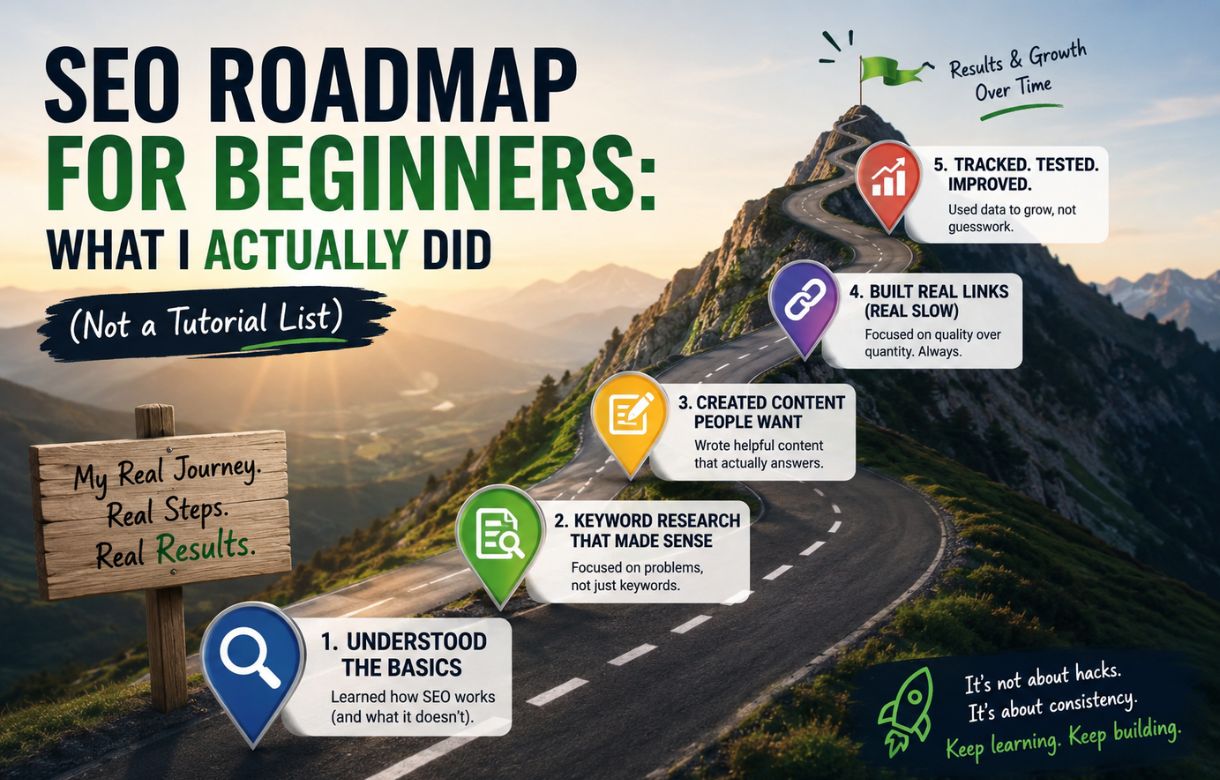
That gap — between a checklist that gets you a temporary win and an approach that actually holds up — is what none of those guides address. This is the roadmap I wish someone had handed me instead: not a list of things to read, but the order in which things actually clicked, including the parts where I got it wrong first.
What does an SEO roadmap actually look like in practice?
Short version: understand what a searcher wants before you touch a keyword tool, pick one narrow topic before you write at volume, and only learn the technical stuff once it’s actually blocking something.
That order matters more than the list of topics itself. Most beginner guides hand you a stack of skills — keyword research, on-page, technical SEO, link building — with no sense of sequence, so you end up trying to learn all four at once and mastering none of them. In practice, they don’t need to happen together, and they definitely don’t need to happen in that order.
Should you learn SEO by reading or by doing?
Neither, on its own. Reading first, doing later is the trap.
It’s tempting to treat SEO like a subject you can finish studying before you start applying it — read enough guides, watch enough videos, and eventually you’ll feel ready. You won’t. SEO isn’t a fixed body of knowledge; it’s a feedback loop between what you publish and what Google Search Console tells you happened. You can’t shortcut that loop by reading more about it.
What worked better: pick one small, real topic, write one real piece of content about it, and let the first Search Console data — even if it’s just a handful of impressions — teach you more than another week of tutorials would. Reading has a role, but it’s a reference you return to when something confuses you, not a runway you have to finish before takeoff.
What’s the first thing you should actually set up?
Google Search Console. Before keyword tools, before a plugin, before you write a single word.
The reason is simple: you can’t learn from what you can’t see. Search Console is free; it’s Google’s own data, and it’s the only tool that tells you what people actually searched to find your page — not what you guessed they’d search. Everything else in this roadmap depends on being able to check that later.
Those early top-ten pages I mentioned — the ones at positions 4 to 6 that later stopped holding — I only knew about them because Search Console was already set up and I was actually checking it. Without that, the temporary win would have been invisible, and so would the drop-off that followed. You need the tool running before the result happens, not after, or you won’t have anything to compare against when things change.
How do you do keyword research when you’re starting from zero?
Start narrower than feels comfortable. Beginners tend to reach for broad, competitive terms because they sound impressive — “digital marketing,” “SEO tips” — and those are exactly the terms you have no chance of ranking for with a new site and zero authority.
The more useful starting question isn’t “what do people search,” it’s “what’s specific enough that almost nobody else has written the honest version of it.” That’s a different skill than plugging a seed keyword into a tool and sorting by volume, and it’s the one that actually produces rankings for a beginner site.
What is on-page SEO, and where do most beginners go wrong?
On-page SEO is everything on the page itself that helps both Google and a reader understand what it’s about — your title, headings, the actual structure of your answer. The mistake beginners make almost universally is treating it as a checklist to satisfy after the writing is done, instead of a shape the writing follows from the start.
A subheading phrased as the exact question someone typed into Google does more for you than five paragraphs of scene-setting before you answer it. That’s not a trick — it’s just matching how people actually read a search result.
Why do most people quit learning SEO before it starts working?
Because they’re stuck consuming instead of publishing, and consuming feels productive in a way that hides how little it’s actually moving them forward.
This is tutorial hell, and it’s not a beginner personality flaw — it’s a predictable trap. Every new guide promises to be the one that finally makes SEO click, so it’s always tempting to read one more before you start. Meanwhile, the person who published one mediocre article three months ago has more real feedback — actual impressions, actual click-through data, actual proof of what worked and what didn’t — than the person who’s read fifty guides and published nothing.
But there’s a second, quieter version of this trap, and it’s the one that actually got me: getting an early win and mistaking it for a system. Those first pages that hit positions 4 to 6 felt like proof I’d figured something out. I hadn’t — not really. I’d done a few things right without understanding which parts mattered, so when the rankings slipped, I had no idea what to fix, because I’d never actually understood what worked in the first place. That’s a harder trap to notice than tutorial hell, because it looks like success while it’s happening.
The fix for both versions is the same, just uncomfortable in a different way: after you publish, write down — actually write down, not just remember — what you think you did and why you think it worked. If a win holds, you’ll have a record to build on. If it doesn’t, you’ll have something concrete to check against instead of guessing at what went wrong. A single article, on a single narrow topic, tracked honestly, is worth more than another week of research or another unexamined win. If you want to see what that looks like at a slightly larger scale — sequencing multiple pieces together instead of one at a time — that’s the exact problem a small content cluster solves, and it’s worth reading once you’ve got your first piece live.
How long does it actually take to see results?
Longer than you want, and there’s no honest way around that. Most new sites take somewhere in the range of several months to build enough trust with Google to rank for anything with real competition — not because you did something wrong, but because that’s roughly how long it takes a new domain to earn the benefit of the doubt.
This is the part most guides either skip or oversell. The skeptical, useful answer is: expect very little for the first stretch, expect it to feel like nothing is working, and expect that to be normal rather than a sign to quit. The people who stick around long enough to find out what “working” even feels like are the ones who treated the quiet months as expected, not as failure.
And once something does start working — once a piece is actually ranking and pulling traffic — the next honest question is what that traffic is worth. Pageviews on their own don’t tell you much until you know what you’re doing with them.
FAQ
Is SEO hard to learn on your own?
Not hard in the sense of requiring special talent, but it does require tolerance for slow, invisible progress — which is a different kind of difficulty than most beginners expect going in
Do you need to know how to code to learn SEO?
No. Most day-to-day SEO work — keyword research, on-page structure, content strategy — requires zero coding. Technical SEO exists, but it’s a specialization you can pick up later, once (and if) it’s actually relevant to a problem you’re facing.
What tools do beginners actually need to start?
Fewer than most lists suggest. Google Search Console and a basic keyword tool cover the real fundamentals. Everything else — rank trackers, backlink checkers, competitor spy tools — is worth adding only once you’ve outgrown what the free basics can tell you.
How do you know if you’re actually improving at SEO?
Not by how much you’ve read — by whether your Search Console impressions and clicks are trending anywhere, even slightly, over a period of months. That’s the only feedback loop that’s actually measuring you against reality instead of against how confident you feel.