
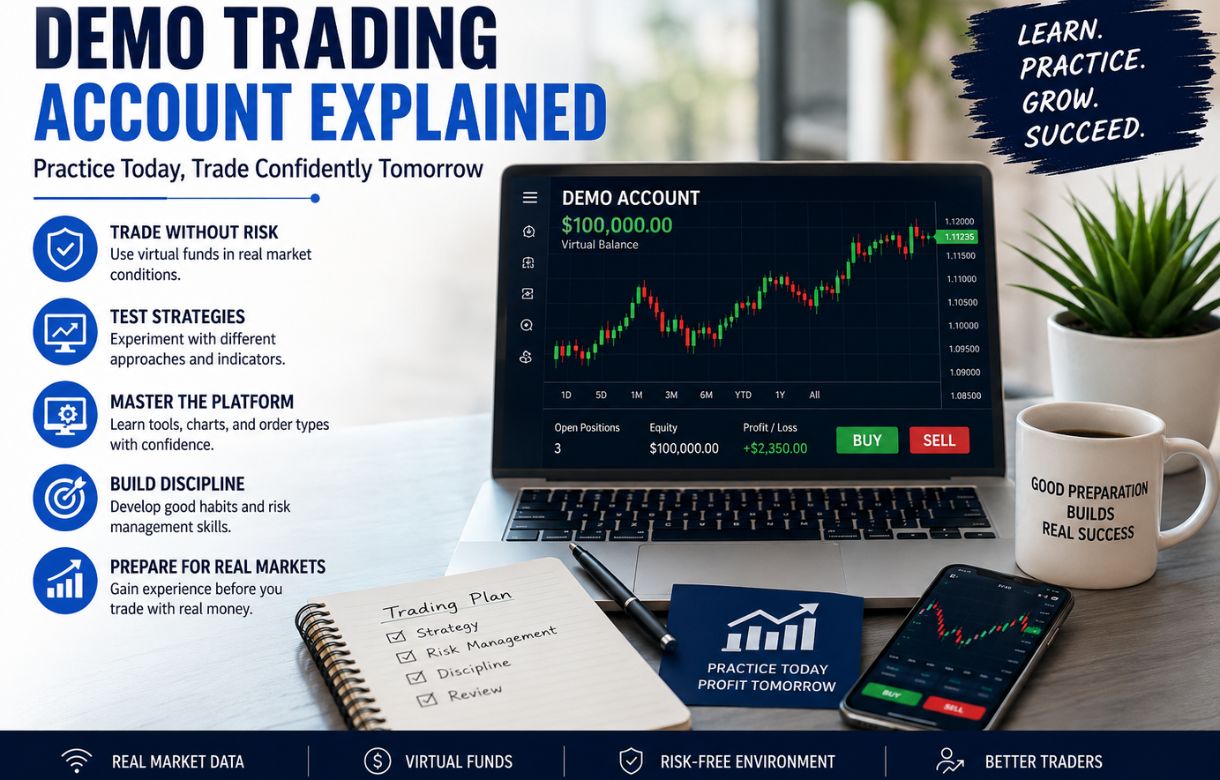
Stepping into the world of online trading for the first time can feel overwhelming. Charts move rapidly, prices swing without warning, and every decision seems tied to financial risk. For beginners, that pressure alone can lead to costly mistakes. That’s exactly why a demo trading account has become such an important starting point for aspiring traders.
Think of it as a practice arena—one that mirrors real market conditions without putting your personal money at stake. It gives traders the chance to explore the mechanics of trading, test strategies, and understand how markets react, all within a safe environment.
Whether someone wants to trade forex, stocks, commodities, or cryptocurrencies, a demo account offers the breathing room needed to learn before diving into live markets.
Table of Contents
ToggleUnderstanding the Purpose of a Demo Trading Account
At its core, a demo trading account is a simulated version of a live brokerage account. It looks and functions almost exactly like a real trading platform, except the funds being used are virtual.
That means traders can buy and sell assets, analyze charts, place stop-loss orders, and experiment with trading strategies without risking actual capital.
For many beginners, this first experience is eye-opening. It’s where they begin understanding how quickly markets move and how important timing, patience, and discipline truly are.
A demo account also removes the fear factor that often freezes new traders. Since there’s no financial consequence attached to mistakes, users are free to learn through trial and error.
How a Demo Trading Account Works
The process is surprisingly simple. Most brokers make it easy to open a demo trading account within minutes.
Typically, users begin by registering on a broker’s platform and selecting the demo option instead of a live account. Once inside, the broker provides virtual funds—often somewhere between $10,000 and $100,000—to simulate a realistic trading balance.
From there, everything resembles a live trading environment.
Market prices update in real time. Traders can open positions, monitor profit and loss, use charting tools, and even test automated strategies. It’s essentially a mirror image of real market activity, only without the emotional weight tied to real money.
This setup allows beginners to focus entirely on learning.
Why Demo Trading Accounts Matter for Beginners
One of the biggest advantages of a demo account is that it creates a risk-free learning experience.
In live trading, one poor decision can wipe out a significant portion of an account. In a demo environment, mistakes simply become lessons. Traders can review what went wrong, adjust their strategy, and try again.
That freedom encourages experimentation.
Some users test technical indicators. Others explore scalping, swing trading, or long-term investing approaches. Many simply spend time learning how to navigate trading software without panicking during fast-moving market conditions.
The more time traders spend practicing, the more comfortable they become with market behavior.
Demo accounts also help users understand how global events affect prices. Economic reports, political developments, and investor sentiment all influence the markets in real time. Watching those reactions unfold inside a demo platform gives traders valuable experience before real money enters the picture.
Also explore:
Expertadvis com: Turning Data Into Smarter Business Strategies
Learning the Trading Platform Without Pressure
Every broker has a different interface. Some platforms are designed for beginners, while others are built with advanced traders in mind.
Without practice, even placing a simple trade can feel confusing.
A demo account removes that stress entirely. Traders can explore chart settings, order types, indicators, leverage tools, and portfolio management features at their own pace.
That familiarity becomes incredibly important later.
In live markets, hesitation can lead to missed opportunities or unnecessary losses. Traders who already understand the platform tend to react faster and make more confident decisions.
The Emotional Difference Between Demo and Live Trading
Even though demo accounts closely imitate real trading conditions, there’s one major element they can’t fully recreate—emotion.
When real money is involved, emotions intensify quickly. Fear, greed, panic, and excitement begin influencing decision-making in ways many new traders don’t expect.
A trader using virtual money may comfortably hold a losing position or take aggressive risks because there’s nothing tangible at stake. That mindset often changes the moment personal funds enter the market.
Live trading also introduces factors like slippage, delayed execution, and liquidity differences during volatile periods. In fast-moving markets, prices can shift before orders are completed.
Understanding these differences is essential because it helps traders transition into live markets with more realistic expectations.
How to Open a Demo Trading Account
Opening a demo account usually takes only a few steps.
Choose a Reliable Broker
The first step is selecting a reputable broker with strong regulatory standing and positive credibility. Security, transparency, and platform stability should always be priorities.
Register Online
Most brokers require only basic personal details for demo access. Unlike live accounts, there’s generally no need to deposit money.
Download or Access the Platform
Traders can usually access platforms through desktop software, web browsers, or mobile applications.
Start Practicing
Once logged in, the virtual balance becomes available immediately, allowing users to begin exploring the markets right away.
Best Practices for Using a Demo Account
Simply opening a demo account isn’t enough. The way it’s used makes all the difference.
Successful traders often treat demo funds with the same seriousness as real money. That means following proper risk management, avoiding reckless trades, and sticking to a clear strategy.
Keeping a trading journal can also be extremely valuable. Recording trades, noting mistakes, and reviewing successful setups helps traders identify patterns and improve decision-making over time.
Another smart approach is setting a practice timeline.
Spending several weeks inside a demo environment allows enough time to understand market behavior without becoming overly dependent on simulation trading.
Common Mistakes Traders Make in Demo Accounts
Ironically, the absence of risk sometimes creates bad habits.
One common issue is overtrading. Since losses don’t feel real, traders may place excessive trades without proper analysis.
Others ignore stop-losses entirely or take oversized positions that would never make sense in a live account.
Some users even begin treating the experience like a game rather than professional preparation.
That mindset can become dangerous later when actual money is involved.
The most effective demo traders are the ones who approach practice seriously and focus on building consistency rather than chasing unrealistic profits.
Transitioning From Demo to Live Trading
Eventually, every trader reaches the point where they feel ready to enter real markets.
The smartest transition is usually a gradual one.
Instead of depositing large sums immediately, many traders begin with smaller amounts to manage emotional pressure. This helps them adjust to the psychological reality of real gains and losses.
It’s also important to continue using the same strategies that worked during demo practice. Abruptly changing trading styles often leads to confusion and inconsistent performance.
Patience matters during this phase.
Confidence built through demo trading can be valuable, but real-market emotions still require adjustment and discipline.
Markets You Can Explore Through Demo Trading
One of the most exciting aspects of demo accounts is the variety of markets available.
Forex Trading
Currency markets move constantly, offering endless opportunities for traders interested in global economic trends.
Stocks and ETFs
Equities allow users to follow companies, sectors, and broader market movements while learning long-term investment behavior.
Commodities
Assets like gold, silver, and crude oil provide exposure to global supply-and-demand dynamics.
Cryptocurrency Markets
Digital assets such as Bitcoin and Ethereum are known for volatility, making them attractive practice grounds for risk management and strategy testing.
Exploring multiple markets helps traders discover which asset class best suits their personality and goals.
Choosing the Right Broker for Demo Trading
Not all brokers deliver the same experience.
A high-quality broker should provide realistic execution, accurate pricing, stable platform performance, and strong educational resources.
Reliable customer support also matters more than many beginners realize. Questions often arise during the learning phase, and responsive assistance can make the experience far smoother.
Security and regulatory compliance should never be overlooked either. Trustworthy brokers operate under recognized financial authorities and maintain transparent operating standards.
Advantages of Using a Demo Trading Account
A demo trading account serves as more than just a beginner tool. It becomes a foundation for long-term trading development.
Inside this simulated environment, traders gain hands-on experience while protecting their real finances. They learn how to interpret price action, manage risks, and refine strategies under realistic market conditions.
More importantly, they develop discipline.
That discipline—combined with patience and market awareness—often becomes the difference between impulsive gambling and structured trading.
By treating virtual trading seriously, users build habits that can later support more confident and informed live-market participation.
Final Thoughts
A demo trading account is one of the smartest starting points for anyone interested in online trading. It offers a safe place to learn, experiment, and understand the realities of financial markets before real money enters the equation.
From testing strategies to mastering trading platforms, the experience gained through demo practice can dramatically improve confidence and preparation.
The markets will always carry uncertainty. But traders who spend time practicing in a realistic, risk-free environment often enter live trading with stronger discipline, sharper instincts, and a much clearer understanding of how the financial world operates.
Frequently Asked Questions
What is a demo trading account?
A demo trading account is a simulated trading platform where users practice trading with virtual funds while experiencing real market conditions.
Is a demo trading account free?
Yes, most reputable brokers offer demo trading accounts completely free for users.
Can I lose real money in a demo account?
No. Demo accounts operate with virtual money, so there’s no risk of losing actual funds.
How long should beginners use a demo account?
Many traders spend around three to six weeks practicing, though the timeline depends on individual comfort and strategy development.


I don’t think the title of your article matches the content lol. Just kidding, mainly because I had some doubts after reading the article.
Thank you for your sharing. I am worried that I lack creative ideas. It is your article that makes me full of hope. Thank you. But, I have a question, can you help me?
Your point of view caught my eye and was very interesting. Thanks. I have a question for you.
Thank you for your sharing. I am worried that I lack creative ideas. It is your article that makes me full of hope. Thank you. But, I have a question, can you help me?
yes, off course
Can you be more specific about the content of your article? After reading it, I still have some doubts. Hope you can help me. https://www.binance.com/register?ref=QCGZMHR6
Can you be more specific about the content of your article? After reading it, I still have some doubts. Hope you can help me. https://accounts.binance.bh/ar-BH/register-person?ref=UT2YTZSU
Your article helped me a lot, is there any more related content? Thanks!